
From Half-MOA to 3 Inches: The Scope Rings Did It

Quick answer: a rifle that used to shoot half-MOA and suddenly shoots 2 to 3 inches almost never needs a new barrel. This .243 came in with shots scattered across the whole target. The scope rings had been overtightened until they crushed the scope tube thirteen thousandths of an inch and snapped the keepers on both rings, and the scope was moving on its own. A known-good shop scope brought it back to a group in one range trip. Bedding the barrel channel, lapping the lugs, a new crown and a real cleaning took it to around an inch with factory ammunition. It went home with the barrel it arrived with.
He did not bring the rifle in because it was a bad rifle. He brought it in because it used to be a good one.
A factory bolt-action in .243 Winchester, owned by a hunter from eastern South Dakota. His words on the intake form were short: "Used to shoot .5 MOA easily, opened up to 2 to 3 inches." That is a specific kind of complaint, and it is the one we like best, because a rifle that has already proven it can shoot half-MOA is telling you the barrel is not the problem. Something changed. The job is to find what.
Here is the intake target.

Look at the pattern before you look at the size. Those are not one big group. They are shots walking around the paper, high left, low left, center, high right, with no two landing near each other. A barrel that has gone bad tends to shoot a big round group. A scope that is moving shoots everywhere. That distinction, on paper, is most of the diagnosis before the rifle ever comes out of the case.
How We Knew the Scope Was Broken Inside Before We Took It Off
We shot it first, and we shot it without touching a thing. No turret clicks, no ring screws, nothing. The groups kept moving anyway. Shot a group, it landed one place. Shot the next, it landed somewhere else. When the point of impact walks around on its own while nobody has adjusted the scope, the reticle is moving inside the tube. That means the internal parts are damaged. A scope can look perfect from the outside and be broken where it counts.
If you want to run the same check on your own rifle, shoot three groups without adjusting anything between them and compare where they land. Our post on what to check when a rifle suddenly shoots bad walks through the whole order we use, and the optic comes before the rifle every time.

What We Found in the First Five Minutes
We pulled the scope. The rings came off in pieces.

Both scope rings had snapped their keepers, the small clamp plates that hook under the base and hold the ring down against recoil. With the keepers broken, the rings were sitting on the rifle, not clamped to it. Every shot, the whole scope could shift a little on the base and settle somewhere new. Every shot, a new zero.
Then we measured the scope tube.


A one-inch scope tube measured 1.0010 inches where the rings had never touched it and 0.9880 inches where they had. The rings had crushed the tube by thirteen thousandths of an inch. You can see the flat spot with the naked eye.

So the scope had two problems stacked on top of each other. The rings were not holding it to the rifle, and the rings had squeezed the tube hard enough to damage the erector assembly, the internal parts that move when you turn the turrets. Once those parts are damaged, the reticle no longer stays where you put it, and no amount of adjusting will hold a zero. Either problem alone will open a rifle up. Together they put shots all over a sheet of paper.

How a Scope Gets Mounted This Badly
We did not mount this scope and we do not know who did, so this is not about a person. It is about the two things that go wrong most often.
The first is torque. Ring cap screws are small, and the correct torque on them is low, far less than most people's wrist wants to apply with a T-handle. Check with the manufacturer of your rings for the torque spec, and use an inch-pound torque wrench rather than feel. We put every published number we could find, ring makers and scope makers both, in a separate reference post, along with what blue Loctite does to them. Overtighten the caps and the ring closes past where it should, the tube deforms, and the excess load goes somewhere. On this rifle it went into the keepers, which are the weakest part of the clamp, and they broke.
The second is alignment. Two rings on a base are almost never perfectly in line with each other out of the box. If they are not lapped or otherwise trued, tightening the caps forces the tube to bend to meet the rings, and the rings bite into the tube at their edges instead of gripping it evenly. That is how you get a flat spot at one ring and a clean tube an inch away.
Neither of these is exotic. Neither takes special tools to avoid. They take an inch-pound torque wrench, a lapping bar, and the willingness to stop tightening when the wrench clicks.
How We Mount a Scope, in Six Steps
This is the order we use on every rifle that gets an optic at Redleg. None of it is secret. All of it gets skipped somewhere every week.
1. Clean and degrease everything. The receiver holes, the base, the ring bottoms, and the screws. Oil and factory preservative under a base let it shift under recoil no matter how tight the screws are.
2. Torque the base to spec. Check with the base manufacturer for the number, use an inch-pound torque wrench, and tighten in a cross pattern so the base seats flat instead of rocking onto one end. A drop of thread locker on the base screws only, never on ring caps.
3. Lap the rings. Set the ring bottoms on the base, run a lapping bar through them, and work it until both rings show contact all the way around. This is the step that keeps a ring from biting the tube at one edge. We wrote the whole process up in Lapping Scope Rings: A Precision Shooter's Guide to Perfect Alignment.

4. Set the scope and level the reticle. Eye relief first, then plumb the reticle. A bubble on the turret cap is a starting point, not proof. The only way to know the reticle is truly level is the tall target test, and we explain how to run it in How to Zero a Rifle for Hunting. A reticle that is a few degrees off will put you left or right of your dope the moment you dial elevation.

5. Torque the ring caps to spec, and stop there. Snug the caps in a cross pattern in small steps, checking that the gap between the ring halves stays even on both sides. Go to the manufacturer's number and no further. This is where the tube on the rifle in this article got crushed.
6. Mark it and prove it. A witness mark across each ring cap and the base screws shows you at a glance if anything has moved. Then boresight, shoot it, and confirm zero before it hunts. For a rifle that is going to be shot hard or at distance, bedding the scope in the rings takes ring stress out of the picture altogether.

If you would rather have it done and proven, scope mounting with boresighting is on our services page, with ring lapping as an option. It is a lot cheaper than a scope.
The Torque Number Is Lower Than Your Wrist Thinks
We pulled the published torque spec from every ring maker, scope maker and rifle maker we could find, and the spread surprised even us. Ring cap screws run from 10 to 35 inch-pounds depending on whose ring it is. Scope makers that publish a limit for the tube itself mostly land at 15 to 18, and a few say 14. Some rings are rated to 25 or 28 and the tube inside them is not. The rule that sorts it out: the lower of the two numbers wins, the ring maker's or the scope maker's. A one-inch tube does not get stronger because the rings could take more.
Blue Loctite changes that number too. Henkel's own data puts a medium thread locker in the same friction range as light grease, so the same click on the wrench delivers 10 to 30 percent more clamp on the tube. Set it to 18 with wet threads and the tube sees what 20 to 24 would have done dry. That is why most ring makers say keep it off the caps and put it on the base screws, and why a few say the opposite for their own products.
The whole chart, every maker, with the sources and the Loctite math, is its own post: How to Mount a Scope, With Torque Specs From Every Maker. It is the reference we wish had existed the day this scope was mounted.
The Shop Scope Test
Before we touched anything else on the rifle, we put a shop scope on it, one we know is good, in rings we know are true, and shot it.

The groups came in immediately. Not to half-MOA, but from "everywhere" to "a group." That is the test that separates a mount problem from a rifle problem, and it costs nothing but a box of ammunition. If the groups had stayed scattered with a known-good scope on it, we would have been looking at the barrel, the bedding, or the action. They did not. The scope was the fault, and now we knew it rather than suspected it.

What the Inspection Found: 41 Items Graded, Two of Them Red
Before any of the work above, the rifle went through the same 41-item accuracy inspection every diagnostic gets. Each item is graded green, yellow or red, and each yellow or red carries the price to fix it, so the customer sees the whole rifle and the whole bill before anyone picks up a tool. This one came back 26 green, 7 yellow, 2 red, and 6 not applicable because nobody was loading for it yet.

The two reds were the mount and the scope. That is the story of this rifle in two lines of a checklist. Everything else was a rifle in good health with a few things worth doing while it was already on the bench.
Item | Grade | What we did | Price |
Mounts and rings | Red | Both keepers snapped, tube crushed 0.013 inch. Replace | Quoted after teardown |
Scope | Red | Reticle moving on its own. Replace | Quoted after teardown |
Bore | Yellow | Heavy copper. Deep cleaning, borescope verified, test fired | $95 |
Crown | Yellow | Recrowned | $150 |
Lug contact | Yellow | Lapped the lugs until both bear evenly | $225 |
Barrel channel | Yellow | Bedded the forend to stop the barrel whip | $95 |
Bedding stress | Yellow | 0.002 inch. Within tolerance for a hunting rifle. Left alone on purpose | $0 |
Bases | Yellow | Torqued to spec with blue thread locker on the base screws | Not billed |
Load development | Yellow | His bench, his sheets, next | $0 |
26 other items | Green | Headspace, chamber, throat, bore dimensions, twist, bolt, firing pin, feeding, trigger, stock. Nothing to fix | $0 |
Accuracy inspection | The report itself, 41 items graded | $150 | |
Total | $715 |
Notice the line we did not bill. Bedding stress came up yellow at 0.002 inch, and 0.002 on a hunting rifle is inside the tolerance that matters. We could have bedded the action for a few hundred dollars and it would not have moved a single shot. The forend was where the money would show up on paper, so that is where it went. A graded report is worth having for exactly that reason: it tells you what to skip as clearly as what to fix.
Total, $715, and $150 of that is the inspection that told us where the other $565 should go. The rings and the scope were the customer's call after he saw the report, and he already had his answer from the shop scope test.
Then We Did the Rest
A rifle that has proven it can shoot half-MOA and is now shooting a solid inch with a good scope is telling you there is a little more in it. So we went through the accuracy work we do on most bolt guns that come across the bench with this kind of complaint.
Bedded the barrel channel, not the action. The inspection dial-indicated the factory action bedding at 0.002 inch of stress. That is inside what a hunting rifle needs, and bedding it again would have been the customer's money down the drain, so we left it alone and said so. The forend was the better dollar: we bedded the barrel channel to take the whip out of a barrel that was flexing on a light stock.
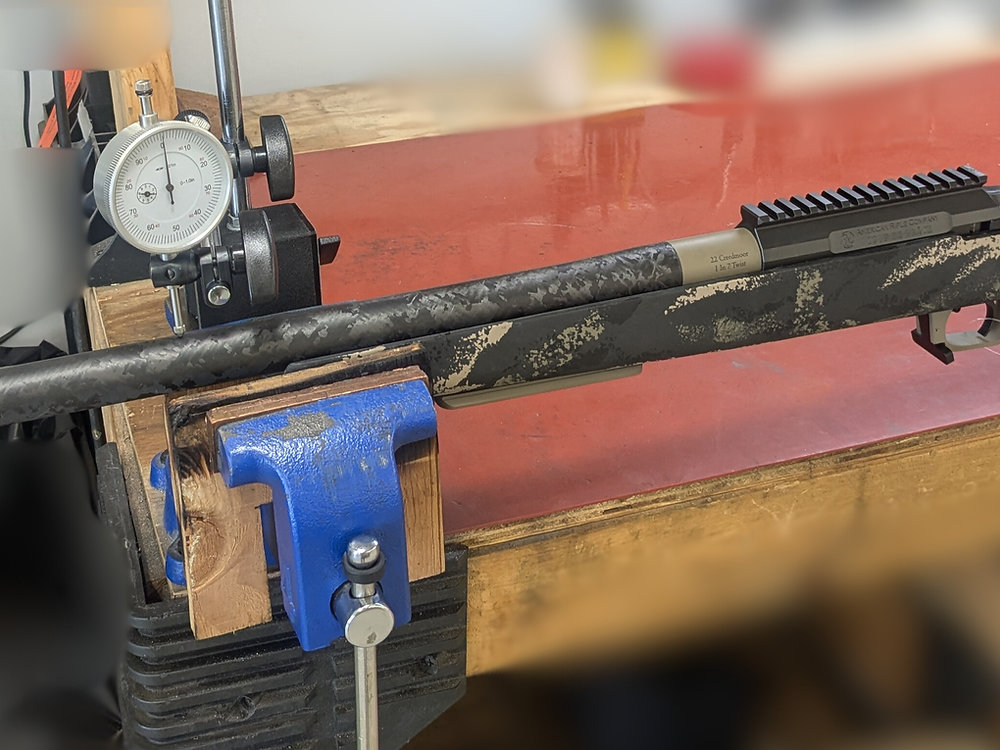
Lapped the bolt lugs. Both locking lugs get worked until they bear evenly on the receiver. A bolt that loads on one lug more than the other puts a small, inconsistent twist into the action on every shot.

Recut the crown. The last thing the bullet touches. A crown that is worn, dinged or slightly off-square lets gas escape unevenly as the bullet exits, and that shows up on paper.
Cleaned the barrel properly. It was full of copper. Heavy copper fouling raises pressure, changes velocity from shot to shot, and hides the true condition of the bore.
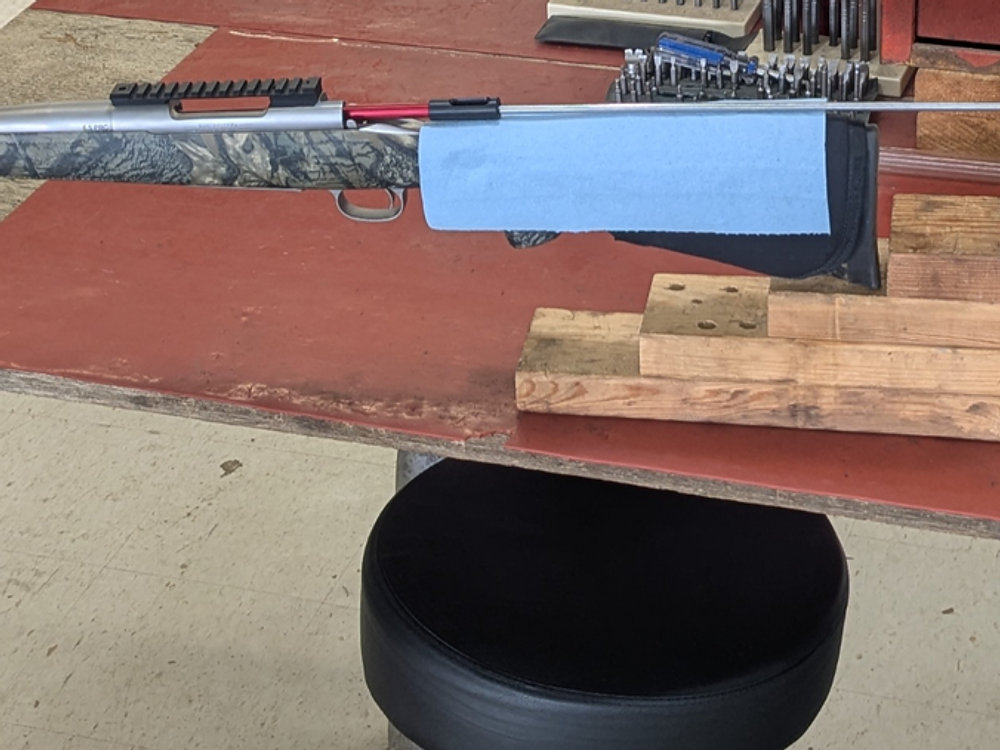
We want to be honest about what this step is. None of it caused the 3-inch groups. The scope did that. This is the work that takes a rifle from fixed to as good as it can be, and it is a separate decision the customer makes with numbers in front of him.
The Result
Four factory loads, three shots each, chronographed, at 100 yards.

Group | Avg velocity (fps) | SD | ES |
1 (center) | 3,039 | 3.9 | 9.4 |
2 | 2,958 | 7.7 | 19.0 |
3 | 2,909 | 10.0 | 22.5 |
4 | 2,846 | 17.1 | 41.6 |
Every load is shooting around an inch. Group 1 has a standard deviation of 3.9 feet per second across three shots, which is the kind of number you usually only see from ammunition somebody built for that specific rifle. Group 4, at the other end, has an SD of 17 and an extreme spread of 41. Same rifle, same day, same shooter, different box. That spread between loads is exactly why the customer is doing what he is doing next.
What He Does Next: Hand Load for It
The rifle is back to being what it was. The customer is now going to hand load for it, and that is the right call. Look at that table again: the difference between the best and worst load on this target is not the rifle, it is the ammunition. A .243 that has been bedded, lapped and crowned, with a scope that is actually attached to it, will reward the effort of a tuned load more than almost anything else you can do to it.
If you are starting down that road, our free reloading sheets are the same ones we use on the bench, a load development log and a range card, laid out to keep you honest about what you changed between sessions.

A Five-Minute Check You Can Do Tonight
You do not need a caliper to catch most of this. With the rifle unloaded and the bolt out, grab the scope by the objective bell and push it firmly forward, back, and side to side. It should feel like part of the receiver. Any give at all is a ring or base problem. Then look at the ring caps: the gap between the two halves should be the same on both sides of each ring. A gap that is closed on one side and open on the other means the cap was cranked down unevenly. Run a fingernail along the tube just ahead of and behind each ring. A ridge you can feel is a tube that has been pinched. Last, check the witness marks, if there are any, and if there are none, make some. Five minutes, and you know whether the scope is the problem before you spend a dollar.
What This Means for Your Rifle
Not every rifle that opens up has a mount problem, and we would be doing you a disservice to say so. Barrels do wear out. Bedding does crack. Stocks do warp. But a rifle that used to shoot and suddenly does not, especially one that throws shots in every direction rather than in one big cluster, deserves five minutes with a screwdriver and a caliper before anyone starts talking about a new barrel.
If you are not sure which kind of problem you have, that is what the accuracy diagnostic is for. We shoot it, we measure it, and you get a graded report, red, yellow, green, with the price of every option next to it before you decide anything. On this rifle, the first thing on that report would have been two broken keepers and a crushed tube, and the conversation would have gone from there.

Accuracy diagnostic, $150. Call 507-677-6007 or see our services.
Frequently Asked Questions
Can scope rings really crush a scope tube?
Yes. Scope tubes are thin-walled aluminum, and ring cap screws have a lot of mechanical advantage. Overtightening the caps, or tightening them onto rings that are not aligned with each other, will deform the tube. On this rifle the tube measured 0.988 inches at the ring against 1.001 inches on the clean section, thirteen thousandths of crush.
What does a crushed scope tube do to accuracy?
The erector assembly inside the scope has to move freely and stay where it is put. A crushed tube can damage it so the reticle moves on its own, and the point of impact wanders from group to group even when nobody has touched the turrets. That is exactly what this rifle did on the first range trip.
How can I tell if the reticle is moving inside my scope?
Shoot three groups without adjusting anything between them. If the groups land in different places while the rings and base are tight and you have not touched a turret, the reticle is moving inside the tube. Put a known-good scope on the rifle to confirm it.
What are the keepers on a scope ring?
On this style of ring, the keepers are the small clamp plates that hook under the base and hold the ring down. They take the recoil load. When they break, the ring is no longer clamped to the rifle. It is resting on it.
How can I tell if my accuracy problem is the scope or the barrel?
Look at the target. A worn barrel usually shoots a large but roughly round group. A moving scope throws shots in different directions with no pattern. The definitive test is to put a known-good scope in known-good rings on the rifle and shoot it again. If it groups, the mount was the problem.
How tight should scope ring screws be?
Check with the manufacturer of your rings and the manufacturer of your scope, use the lower of the two numbers, and use an inch-pound torque wrench, not feel. Published numbers run from 10 to 35 inch-pounds depending on the maker; our scope mounting and torque spec post lists every one. The most common mistake we see is not too loose. It is far too tight.
Should I put Loctite on scope ring screws?
Most makers say no. Vortex, Warne, Talley, Badger and Geissele all say keep it off the caps, because their torque numbers assume dry threads and thread locker lowers friction, which puts 10 to 30 percent more clamp on the tube at the same wrench setting. A few makers say the opposite for their own products. Blue on the base screws is fine and most makers recommend it. Follow the maker of the rings you have.
The scope maker and the ring maker give different torque numbers. Which one wins?
The lower one. Spuhr, EGW and Reptilia print exactly that on their instruction sheets. Vortex scopes are 15 to 18 inch-pounds regardless of what rings they sit in, Swarovski is 17.7, and some rings are allowed up to 28 only because the ring maker is rating the ring, not the tube. The tube is what you are protecting.
Do scope rings need to be lapped?
For a rifle you expect to shoot well, yes, or at least checked for alignment. Two rings on a base are rarely perfectly in line. Lapping trues them to each other so the tube is gripped evenly around its circumference instead of pinched at the edges.
How do I know my scope is actually level?
A bubble level on the scope is a starting point. The tall target test is the proof: shoot at the bottom of a tall plumb line, dial up a large amount of elevation, shoot again, and see whether the second group climbed straight up the line or drifted to one side. We explain the whole test in our zeroing post.
Why did you put a shop scope on it before doing anything else?
Because it is the cheapest, fastest way to isolate the problem. If the rifle groups with a known-good scope, the mount was the fault. If it does not, the problem is in the rifle. Ten rounds tells you which, and it costs the customer nothing but the ammunition.
Why did you bed the barrel channel and not the action?
Because the dial indicator said the action did not need it. Factory bedding stress measured 0.002 inch, which is within tolerance for a hunting rifle, so a full bedding job would have cost the customer money and gained him nothing on paper. The barrel channel was different: the barrel was whipping on a light forend, and bedding the channel is a $95 fix for that. We spend the customer's money where the report says it will show up on the target.
What does lapping the bolt lugs do?
It makes both locking lugs bear evenly against the receiver. A bolt that loads on one lug puts a small, inconsistent twist into the action on every shot. Lapping removes it.
Why recut a crown on a rifle that used to shoot well?
Because crowns wear, and because it is inexpensive insurance once the rifle is already on the bench. The crown is the last thing the bullet touches, and any unevenness there lets gas escape unevenly as the bullet leaves.
How much copper fouling is too much?
If velocity is drifting shot to shot and the bore looks pink under a light, it is too much. Heavy copper raises pressure and hides the true condition of the barrel. This rifle was heavily fouled and had likely never been cleaned past the visible-dirt stage.
Should I hand load for a hunting rifle?
If the rifle has been set up properly and you are willing to keep records, yes. On this target the best and worst factory loads were separated by an SD of 3.9 versus 17.1, same rifle, same day. That gap is ammunition, and a tuned hand load closes it. Our free reloading sheets are the place to start.
What does an accuracy diagnostic at Redleg cost?
$150. We shoot the rifle, measure it, and give you a graded report with the price of each option before you decide anything. Most people find out what they actually need, which is often less than they feared.
Questions about a rifle that used to shoot? Call Redleg Company at 507-677-6007, or bring it in. 430 Main Avenue, Chandler, Minnesota. Monday to Friday, 9 to 5.


Comments