
The Science of How We Perform Rifle Barrel Cleaning | Redleg Precision Guns Chandler, MN

Updated: 8 hours ago
The True Measure of a Rifle Isn’t How It Shoots Dirty It’s How It Shoots Clean.
Every precision shooter eventually learns the same painful truth: Barrels don’t lose accuracy overnight. They lose it one careless cleaning at a time.
At Redleg Precision Guns in Chandler, Minnesota, we build and maintain rifles that live at the intersection of craftsmanship and science. We chamber, bed, and tune rifles for PRS, F-Class, ELR, and precision hunting and we’ve scoped, measured, and dissected more bores than most shooters will ever own.
This is not a beginner’s guide. This is how a barrel maker and a benchrest champion clean a rifle for maximum accuracy, minimum wear, and total repeatability.

1. Barrel Fouling: The Microscopic Enemy of Accuracy
When a bullet travels through the bore, it experiences 60,000 PSI of pressure, 3,000°F of temperature, and up to 200,000 RPM of spin. That violent microenvironment changes steel.
The first few microseconds after ignition determine how your bullet is engraved by the lands and that interaction is affected by what’s left behind from the previous shot.
The Three Fouling Layers That Kill Consistency
Soft Carbon (Layer 1), Dry powder residue that coats the bore after each shot. Easy to remove, but if left alone, it bakes into hard carbon.
Hard Carbon (Layer 2), A ceramic-like film at the throat and first few inches of rifling. It distorts pressure curves, ruins ES/SD, and causes verticals at distance.
Copper (Layer 3), Smeared bullet jacket material that embeds into microscopic pores. Over time, this copper layer can change bore dimensions by up to 0.0003” enough to destabilize a match bullet.
The “Equilibrium Zone”
Elite shooters and barrel manufacturers agree a perfectly clean bore doesn’t shoot its best. The ideal condition is a “balanced fouling equilibrium” a thin, uniform layer of carbon and copper that stabilizes friction and seals micro imperfections. Your job isn’t to remove everything it’s to reset the bore back to its sweet spot.
2. Understanding Steel: The Barrel Maker’s View
Every barrel has a unique microstructure. Stainless barrels (416R, 410) and chrome-moly barrels (4140/4340) respond differently to heat and solvent.
Stainless Barrels
Easier to clean and less prone to corrosion.
Softer grain structure over-brushing or abrasive use can “open” the grain and accelerate fouling.
Prefer chemical cleaning and minimal mechanical work.
Chrome-Moly Barrels
Harder and more fouling-prone due to micro-pitting from machining.
Benefit from light abrasive bore pastes during maintenance intervals.
Can handle slightly more brush work, but always use nylon.
Hand-Lapped vs Non-Lapped
A hand-lapped bore will foul predictably and clean easily. A non-lapped bore builds irregular carbon and copper deposits that require more frequent, but gentler, cleaning cycles.
At Redleg, we borescope every build. We know each barrel’s fouling pattern and we teach our clients to learn theirs.
3. Tools of the Precision Rifle Barrel Cleaning
You can’t get precision results with sloppy tools. Here’s the professional Redleg setup that mirrors top barrel manufacturers:
Tool | Purpose | Notes |
Bore Guide | Keeps rod centered & protects throat | A must never clean without one. |
One-Piece Coated Rod | Prevents flex & galling | Dewey or BoreTech; no sectional rods. |
Aluminum Jag | Eliminates false copper readings | Brass reacts with solvent; aluminum doesn’t. |
Nylon Brush | Gentle agitation | Replace every 500 strokes; clean after use. |
Chamber Brush | Clears carbon ring | Use every 3 to 5 cleanings. |
JB Bore Paste | Controlled abrasive for fire-cracked or rough bores | Used sparingly; restorative, not routine. |

Solvents:
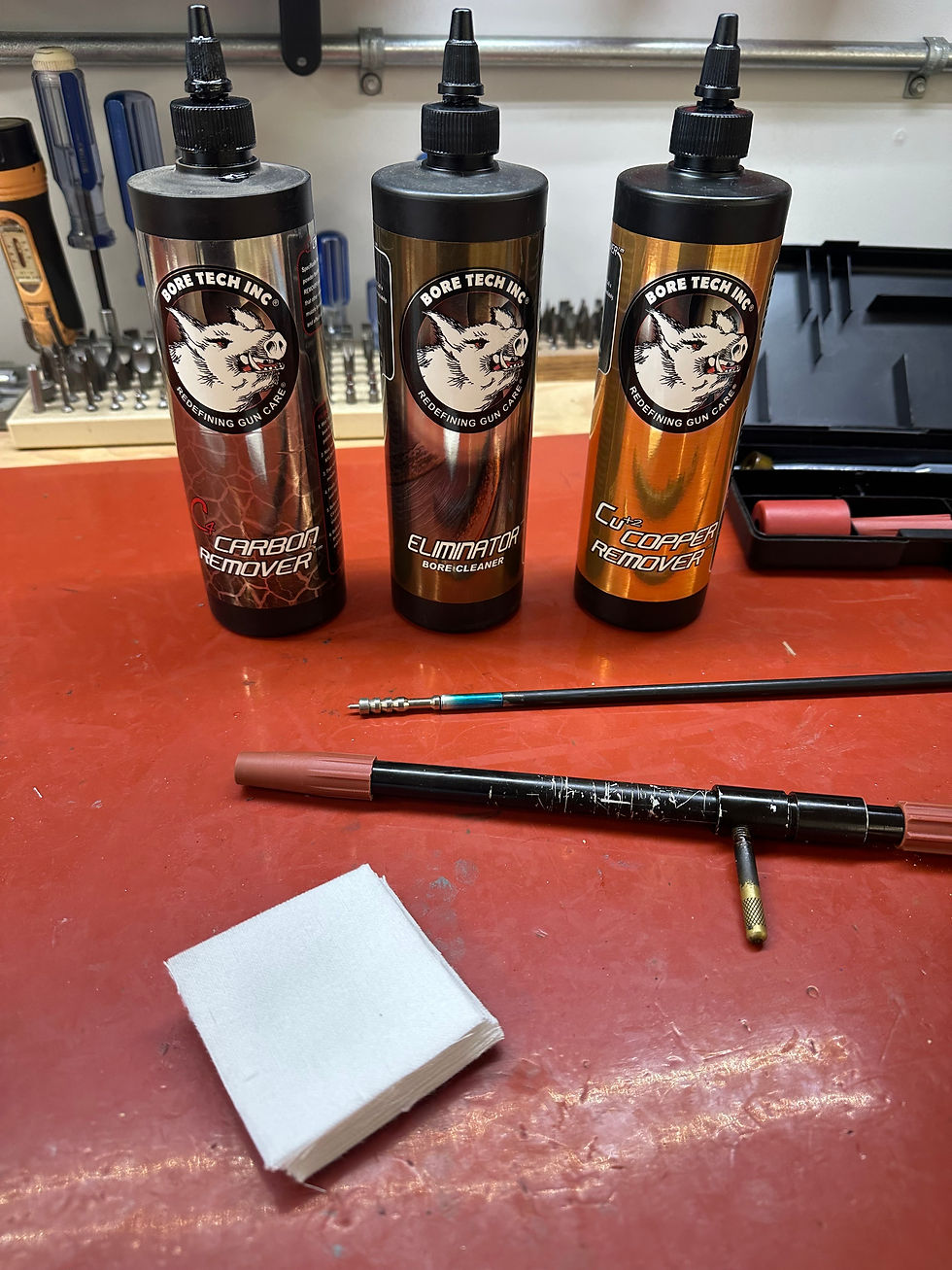
BoreTech C4 Carbon Remover
BoreTech Cu+2 Copper Remover
BoreTech Friction Guard or Kroil for post-cleaning protection
4. The Redleg Cleaning Process (Advanced)
Step 1: Pre-Clean Inspection
Use a borescope to map your fouling. You should know where your carbon ring starts, where copper layering begins, and how your lands look. If you clean blind, you’re guessing and guessing ruins barrels.
Step 2: Carbon Phase
Soak a patch with BoreTech C4 and push through once.
Let it sit 5 to 10 minutes.
Pass 10 to 15 full-length nylon brush strokes.
Push 2 to 3 clean patches until they come out gray, not black.
Avoid: back-and-forth scrubbing over the throat. Always full passes.

Step 3: Copper Phase
Apply BoreTech Cu+2 and let it sit for 5 minutes.
Push patches until the blue color fades (no copper reaction).
If you see persistent blue after 10 patches, inspect again may be copper trapped in rough lands.

Step 4: Mechanical Conditioning (Only When Needed)
If you see:
Fire cracking near the throat
Vertical streaking under the borescope
Sticky fouling after 20 to 30 rounds
Then use JB Bore Paste or Iosso on a tight patch:
20 to 30 strokes from throat to muzzle (never reverse mid-bore)
Follow with carbon solvent and patches to neutralize.

This is not polishing it’s burnishing. It re-levels carbon scars and closes micro-pits. Done right, it can restore lost accuracy in a tired barrel.
Step 5: Chamber & Carbon Ring Removal
The most common cause of “sudden pressure spikes” isn’t the load it’s a carbon ring.

Use a chamber brush soaked in solvent:
Rotate 6 to 10 turns in the neck and shoulder area.
Patch dry and inspect with a scope.

The throat should appear bright, not hazed or blackened.
5. Cleaning Schedules by Discipline
Benchrest / F-Class
Clean every 25 to 40 rounds.
Use only chemical cleaning.
Re-foul with 2 to 4 shots before next group.
PRS / NRL
Clean every 150 to 250 rounds, depending on powder and suppressor use.
Focus on carbon control copper removal every 2 to 3 sessions.
Use borescope data to define your pattern.
Precision Hunting
Light clean after every hunt or 20 to 40 rounds.
Always dry patch after exposure to moisture.
Leave a trace of copper fouling for cold-bore consistency.
6. Post-Clean “Re-Foul” and Accuracy Conditioning
Every barrel needs to “settle” after a deep clean. This isn’t superstition it’s physics.
A perfectly clean bore has no carbon seal, so gas escapes microscopically around the bullet jacket. As you shoot, fouling reseals those pores.
Benchrest rifles: Stabilize within 3 to 5 rounds.
PRS rifles: 10 to 12 rounds.
Hunting rifles: 2 to 3 rounds.
If your first cold bore shot impacts differently after cleaning, note how many rounds it takes to stabilize that’s your rifle’s conditioning curve.
7. Borescope Evaluation: The Redleg Standard
A borescope tells the truth no solvent bottle can.
What we look for:
Uniform carbon layer after 30 rounds = ideal fouling balance.
Uneven copper on land edges = need for reconditioning.
Dark throat discoloration = fire cracking or early erosion.
If your bore starts showing flaking carbon that doesn’t patch out, you’re not cleaning often enough. If it shows bright, raw steel after every cleaning, you’re cleaning too aggressively.
8. The “No-Go” List: Common Barrel Killers
Sectional Cleaning Rods, They whip, scrape, and destroy throats.
Brass Jags with Copper Solvent, Creates false blue, leading to over-cleaning.
Aggressive Copper Brushes, Steel brushes scratch lands.
Improper Crown Contact, One ding ruins accuracy.
Mixing Solvents, Chemical reactions that can etch bore steel.
Pushing Patches Backwards, Pulls debris back into the throat.

9. Long-Term Barrel Preservation (Hunting & Storage)
For rifles stored between seasons:
Run a patch with BoreTech Friction Guard or Kroil.
Plug both ends with rubber stoppers.
Store muzzle-down to prevent solvent creep into bedding.
Before shooting, run a dry patch always.
For field rifles in humid Midwest climates (like Southwest Minnesota):
Avoid WD-40 or generic oils they can congeal and affect cold-bore shots.
Use corrosion inhibitors designed for firearm steel.
10. The Philosophy of Barrel Maintenance
At Redleg, we don’t “clean rifles.” We condition them for longevity.
When rifle barrel cleaning every travel of a patch is as deliberate as a trigger break controlled, measured, and repeatable.
We’ve seen barrels go 4,000 rounds and still print bugholes not by luck, but by discipline.

Ready to Take Your Precision to the Next Level?
At Redleg Precision Guns, we don’t just build rifles we build instruments of precision, tuned for your shooting discipline, and handcrafted to perform flawlessly from the first round to the thousandth.
You’ve just learned how to maintain your barrel like a world-class shooter now imagine what your performance looks like behind a rifle that was built, chambered, and tuned by the same craftsmen who wrote this guide.
The Tools Behind Every Redleg Rifle. Get the exact Reloading Sheets we use to test and tune every precision build. Designed for accuracy-obsessed shooters who demand results, not excuses.

Call: (507) 677-6007
Email: info@redlegguns.com
Start Your Custom Build: www.redlegguns.com


Take advantage of this limited-time opportunity to own a Redleg rifle built to the same uncompromising standards used by the world’s best shooters.
The most stubborn fouling problem gets its own guide: How to Identify and Clean Carbon Rings in Rifle Barrels And Why It Matters for Precision Shooters.


Comments