
Do You Actually Need a New Barrel? A Weatherby Mark V, a $150 Diagnostic, and 0.4 Inches

Updated: Sep 21
Quick Answer
"Do I need a new barrel?" Most of the time, no. Before you spend the money, change the ammunition, then have the rifle measured. A .280 Ackley Improved Weatherby Mark V came to us shooting about three inches at 100 yards and its owner assumed it needed a rebarrel. Six factory loads did not fix it. A $150 accuracy diagnostic graded 41 items: 30 green, 5 yellow, zero red. Cleaning, recrowning, lapping the lugs and bedding the stock cost $725 and took it to 0.8 inches. Bedding the barrel at the forend took it to about 0.4 inches over five shots. It went home with the barrel it arrived with.
A customer shipped us a Weatherby Mark V in .280 Ackley Improved this summer. His request was specific, and specific is the best kind of request a shop can get, because it is measurable.
"I want it to hit deer vitals consistently at 500 yards. Right now, it is not set up to do that."
The rifle was shooting around three inches at 100 yards. Like most people in that position, he assumed the answer involved a new barrel.
It did not.

First We Changed the Ammunition, Because That Is the Cheapest Thing to Change
Before a single tool came out, we shot the rifle with six different factory loads. Federal, Nosler, some AccuBond, Hornady and a couple of others. If a rifle can be fixed by a box of ammunition, that is the answer everybody wants and it is the one we look for first.

It did not fix it. Every load got shot over a three shot group, and they ran from about three inches down to about two and a half. Half an inch of difference between the best box and the worst box, and nothing close to what he was asking the rifle to do.

That result is not a dead end. It is information, and it is the reason the inspection was worth doing.
When a rifle shoots about the same size group no matter what you feed it, something mechanical is setting the floor, and no box on the shelf is going to get underneath it. That is the point where guessing starts getting expensive, and where a diagnostic stops being an upsell and becomes the cheap option.
What a $150 Accuracy Diagnostic Actually Is
It is not a guess and it is not a test fire. It is a documented bench evaluation of 41 separate checks across six systems: the barrel, the bolt and action, the stock and bedding, the trigger, the scope and mounts, and the ammunition and dies.
Every item is graded green, yellow or red. Green means it is right. Yellow means it is out of spec but the rifle is safe and functional. Red means it needs attention before the rifle is fired again. Anything that does not apply is marked N/A rather than skipped quietly.
You get the whole sheet. Not a summary, not a verbal, and not only the items we would like to sell you. Here is the actual report from this rifle, with the owner's name and serial number removed.


What We Found on This Rifle
Forty one items rated. Thirty green, five yellow, zero red, and six that did not apply.
Here are the five yellows, quoted from the report exactly as they were written on the bench:
• Bore: large amount of copper
• Crown: large amounts of dings, not crisp
• Lug contact: 2 of 6 lugs touching
• Bedding stress: .015 inch, when we ideally want less than .002
• Barrel channel: not free floated
Now read the list again and notice what is not on it. Headspace, green. Chamber and throat, green. Bore slugging, green. Twist rate, green. The scope, the bases, the rings and the trigger were all green.
Zero red. Nothing on this rifle was broken or unsafe. It was a good rifle that had never been made to work as one system.
Why Zero Red Is the Most Important Line on the Report
A three inch rifle feels broken to the person shooting it. The temptation, for the owner and for the shop, is to assume the barrel is finished and start over.

But a worn out barrel shows up in the borescope and in the numbers, and this one did not. The bore was dirty, not eroded. The crown was dinged, not washed out. Those are fixable in an afternoon for a fraction of what a rebarrel costs.
That is the entire reason we diagnose before we build.
What We Recommended, and What It Cost
Four services, priced line by line before anything was touched. A complete cleaning, $100. Recrown the barrel, $150. Lap the lugs, $225. Bed the stock, $250. Seven hundred and twenty five dollars in total, and every one of those numbers was on the report before he said yes.
He approved the work the same evening the report went out, with one note attached: call me before performing services. We did.
For scale, a rebarrel on this rifle starts at $450 in chambering labor before you buy the barrel, before threading, and before any bench time. The diagnostic that ruled it out cost $150.
What Actually Changed
A bore full of copper is not a worn bore, it is a dirty one, and the fix is a hundred dollar cleaning rather than a new barrel. That distinction is worth roughly a thousand dollars to the man who owns the rifle.
Two of six lugs touching means the bolt was loading against a third of the surface it should have been, and it was loading unevenly. Lapping fixed that.

A crown with dings in it means gas leaves the muzzle unevenly behind every single bullet. Recrowning fixed that.
Fifteen thousandths of bedding stress, against the two thousandths we want to see, means the stock was twisting the action every time the screws came to torque. Bedding fixed that.
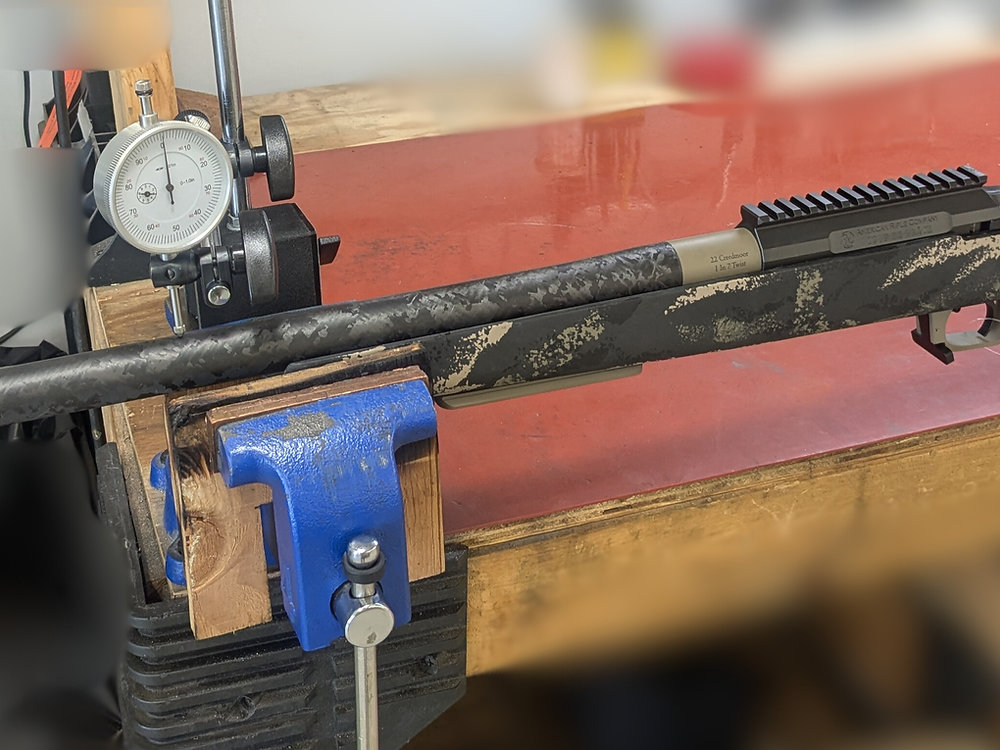
The rifle came down to a 0.8 inch three shot group at 100 yards, on the same Hornady Precision Hunter 162 grain ELD-X it had been shooting from the start. Three inches to under an inch, without a new barrel.

Then He Asked for More, and This Is Where Most Shops Sell a Barrel
We sent him the group and asked whether it was acceptable. His answer: "Try a few more, see if you can get it a little better."
So we told him the truth, in writing: "If you want smaller groups with the rifle, our next steps are reloading or installing a new barrel."
That was an honest sentence. It was also an easy sale. He did not take it.
What we did instead was go back to the one yellow on the report that never had a service attached to it. The barrel channel was not free floated. Nobody had quoted it, and nobody was going to be billed for it.
The Half MOA Nobody Billed For
We bedded the barrel near the forend and adjusted the pressure. The rifle went to about 0.4 inches, and we shot that one five times instead of three.
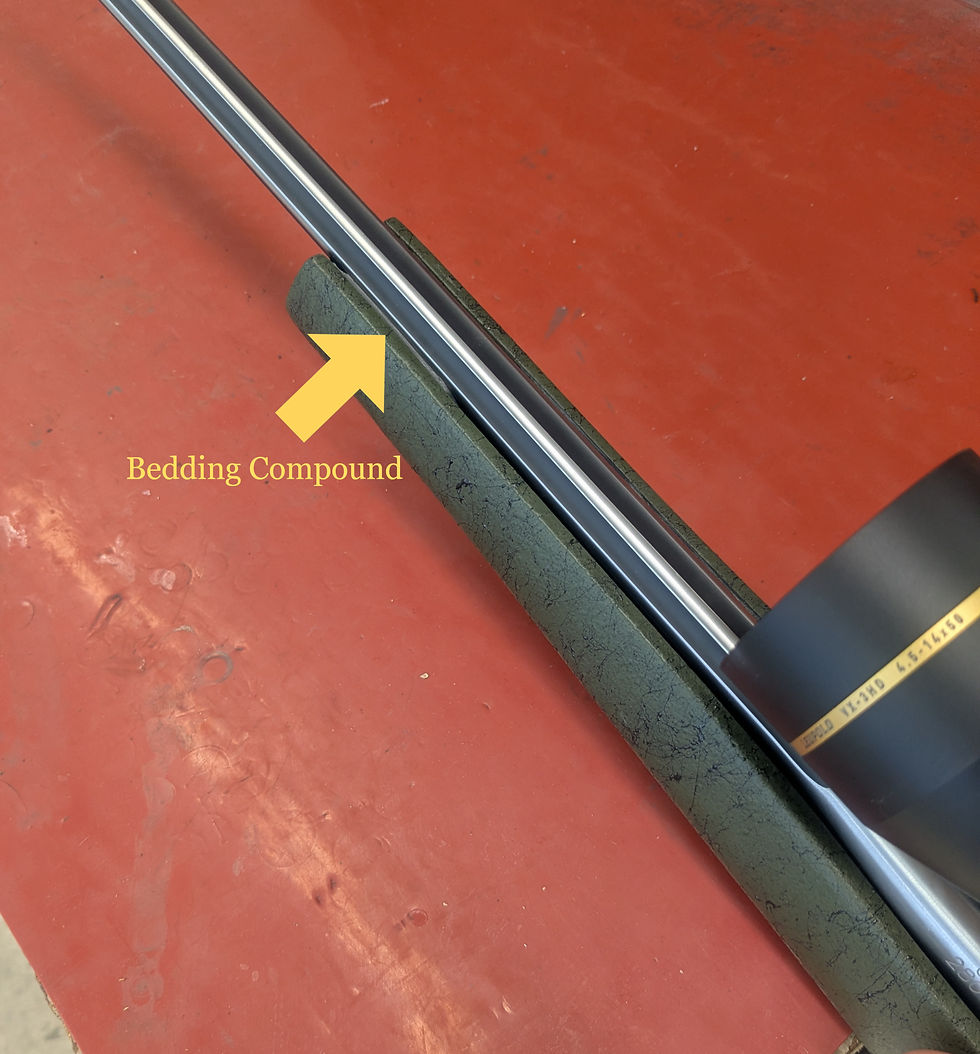
Half of what it had been that morning, and roughly a fifth of what it was when it arrived. No new barrel, no handloads, and no additional charge for the fix.
That last number deserves one more sentence, because it is the sentence most shops leave out.
Everything up to this point was shot over three rounds. The last group was shot over five. The group got smaller while the sample got bigger, and that is the harder way to do it. Three shots will flatter any rifle on a good day. Five will not, and five is what we chose to publish.

Does It Answer the Question He Actually Asked?
He never asked for a small group. He asked to hit deer vitals consistently at 500 yards.
At 0.8 inches we told him he was looking at roughly a four inch group at 500 yards under ideal conditions. At 0.4, the mechanical dispersion is closer to two. A whitetail vital zone is eight to ten inches.
The rifle now has several times the precision the job requires, and that margin is exactly what absorbs wind, an imperfect position, and a cold barrel on the one morning it matters.
We zeroed it at 100 yards on the ammunition it likes and built a dope card out to 550 yards with elevation and wind holds at five and ten miles per hour. It ships with the rifle. His words when he saw the last target were "Good job man!"
The load is Hornady Precision Hunter 162 grain ELD-X, running 2,814 feet per second out of this barrel. Here is the card that went home with the rifle, in MOA, with wind holds for a five and a ten mile per hour full value wind.
Range (yards) | Elevation MOA | Wind 5 mph | Wind 10 mph |
50 | -0.67 | 0.13 | 0.25 |
100 | 0 | 0.27 | 0.53 |
150 | -0.51 | 0.39 | 0.78 |
200 | -1.38 | 0.52 | 1.04 |
250 | -2.42 | 0.65 | 1.31 |
300 | -3.57 | 0.79 | 1.58 |
350 | -4.81 | 0.93 | 1.86 |
400 | -6.13 | 1.08 | 2.15 |
450 | -7.51 | 1.23 | 2.45 |
500 | -8.97 | 1.38 | 2.76 |
550 | -10.49 | 1.54 | 3.07 |
Zero is at 100 yards. At 500 he holds just under nine minutes of elevation, and a ten mile per hour crosswind is worth about two and three quarter minutes. That is the whole argument for a dope card: elevation is predictable and can be printed, and the wind is the part you still have to read.
Why His Turret Is Cut for 5,000 Feet
Once the card was in his hands he asked whether we do custom turrets. We do, and we ordered one, cut for this load and for shooting at five thousand feet of elevation.
That last detail matters more than it sounds. A dope card is only true for the air it was built in.
Ours was built here in southwest Minnesota, at 1600 feet above sea level. Where he hunts, the air is thinner and the same bullet will not drop the same amount at distance. Cutting the turret for the elevation he actually shoots at is what makes the number on the dial agree with the hole in the target.
None of that was on the original work order. It came out of a phone call after he had the card in hand, which is usually where the useful part of a job turns up.
When a New Barrel Really Is the Answer
We are not saying nobody needs a rebarrel. Plenty of rifles do, and we chamber and fit barrels here every week.
A barrel is the answer when the borescope shows real throat erosion, when slugging turns up dimensional problems, when the numbers say the bore is worn rather than dirty, or when the rifle has already been made mechanically correct and still will not group.

The point is that you should know which one you have before you spend the money. That is a $150 question, and it is worth asking first.
The Short Version
• Arrived at about 3 inches at 100 yards on five or six factory loads. The owner assumed it needed a barrel.
• 41 checks: 30 green, 5 yellow, 0 red. Nothing was broken.
• Cleaning, recrowning, lug lapping and bedding took it to a 0.8 inch three shot group.
• A free float fix nobody had quoted took it to about 0.4 inches, that one over five shots.
• Zeroed, dope card to 550 yards, shipped home. Same barrel it arrived with.
Frequently Asked Questions
Do I need a new barrel, or can my rifle be fixed?
Most rifles that will not group do not need a new barrel. A barrel is the answer when the borescope shows real throat erosion, when slugging turns up dimensional problems, or when the rifle has already been made mechanically correct and still will not shoot. It is not the answer when the bore is fouled, the crown is dinged, the lugs are not bearing evenly or the stock is stressing the action. Those are all fixable, and on this Weatherby they were worth about two and a half inches of group size.
What is an accuracy diagnostic, and what does it include?
It is a documented bench evaluation of 41 separate checks across six systems: the barrel, the bolt and action, the stock and bedding, the trigger, the scope and mounts, and the ammunition and dies. Every item is graded green, yellow or red, or marked not applicable. You get the whole sheet, with each recommended service priced, before anything is approved. It is $150 at our shop.
How do I know if my barrel is shot out?
You look at it and you measure it. Real throat erosion shows up in a borescope as cracking and roughness ahead of the chamber, and slugging the bore turns up dimensional problems. Copper fouling and a dinged crown look bad but are not wear, and they clean up. If nobody has put a borescope down your barrel, nobody actually knows whether it is worn out.
How much does it cost to rebarrel a rifle?
Chambering labor on a bolt rifle like this one starts at $450, and that is before you buy the barrel and before threading or any other bench time. A full accuracy diagnostic is $150. That gap is the entire reason to diagnose before you decide.
Should I try different ammunition before paying for gunsmithing?
Always. It is the cheapest variable in the system and now and then it is the whole answer. We tried five or six factory loads on this rifle before picking up a tool. When every load prints about the same size group, you have learned something worth knowing, and that is the moment to start looking at the rifle itself.
Does a dirty barrel really hurt accuracy?
It can, badly. This one had a large amount of copper in it. Fouling changes how the bullet engages the rifling and it builds unevenly, which is why groups open up as a session goes on. A hundred dollar cleaning was the first service on the list. A bore full of copper is a dirty barrel, not a worn one.
Can bedding fix a rifle that will not group?
Yes, and it is one of the most common fixes there is. This rifle measured fifteen thousandths of bedding stress where we want to see under two, which means the stock was twisting the action every time the action screws came to torque. Bedding the stock, and later bedding the barrel near the forend, accounted for most of the improvement on this rifle.
Does a barrel have to be free floated to shoot well?
No, and that surprises people. Free floating is the usual answer because it removes an uncontrolled variable, but uncontrolled is the operative word. What hurts a rifle is inconsistent contact between the barrel and the stock. On this Weatherby we did the opposite of floating it: we bedded the barrel near the forend and set deliberate, repeatable pressure against it, and the group came down by half.
What does lapping the bolt lugs actually do?
It makes the locking lugs share the load evenly. This rifle had two of six lugs touching, so the bolt was bearing on a third of the surface it should have been, and bearing on it unevenly. Lapping brings the rest into contact so the action closes on the cartridge the same way every time.
How many shots should an honest group be?
More than three, if you want to believe it. Three shots will flatter almost any rifle on a good day. We shot three shot groups through the diagnostic work on this rifle and then shot the final group over five, and it still came in at about four tenths of an inch. If a shop shows you a group and does not tell you the round count, ask.
Does a dope card work anywhere, or only where it was made?
Only where it was made, near enough. A dope card is built for a specific load at a specific muzzle velocity in a specific density of air. Take a card built at a few hundred feet of elevation up into thin mountain air and the drops will not match at distance. That is why this customer's custom turret was cut for the elevation he actually hunts at rather than the one we shot at.
Can I ship my rifle to Redleg from another state?
Yes, and it is routine. This rifle came to us from out of state and the owner has never been in our shop. Everything happened by email, photographs and phone calls. Call us and we will tell you how to pack and send it.
How a Rifle Gets Here From Another State
This customer has never set foot in our shop. He found us through a form on this website, told us what his rifle was doing, and shipped it in. Everything after that happened by email, photographs and phone calls.
That is routine, not unusual. A rifle can be shipped to a licensed gunsmith for work and sent back when it is finished, and we will walk you through exactly how to pack and send it.
If your rifle is not in Minnesota, that is not an obstacle. Call the shop and we will tell you how to get it here.
Who Did This Work
Redleg Company Inc is a working gunsmithing and machine shop in Chandler, Minnesota, holding a Type 7 FFL and a Class 2 SOT. Chambering, threading, bedding, Cerakote and suppressor work are done at our own benches rather than sent out.
Every measurement in this article was taken here and written down as it was taken. The report shown above is the same document the customer received, with his name and serial number removed.
If your rifle will not group and you are trying to decide whether to fix it or replace the barrel, our accuracy diagnostic is $150 and it ends with a written report and graded options rather than a guess. Call the shop at 507-677-6007 and we will tell you what your rifle actually needs.
Related Reading



Last updated August 2026.
Track your own rifle the way we track ours
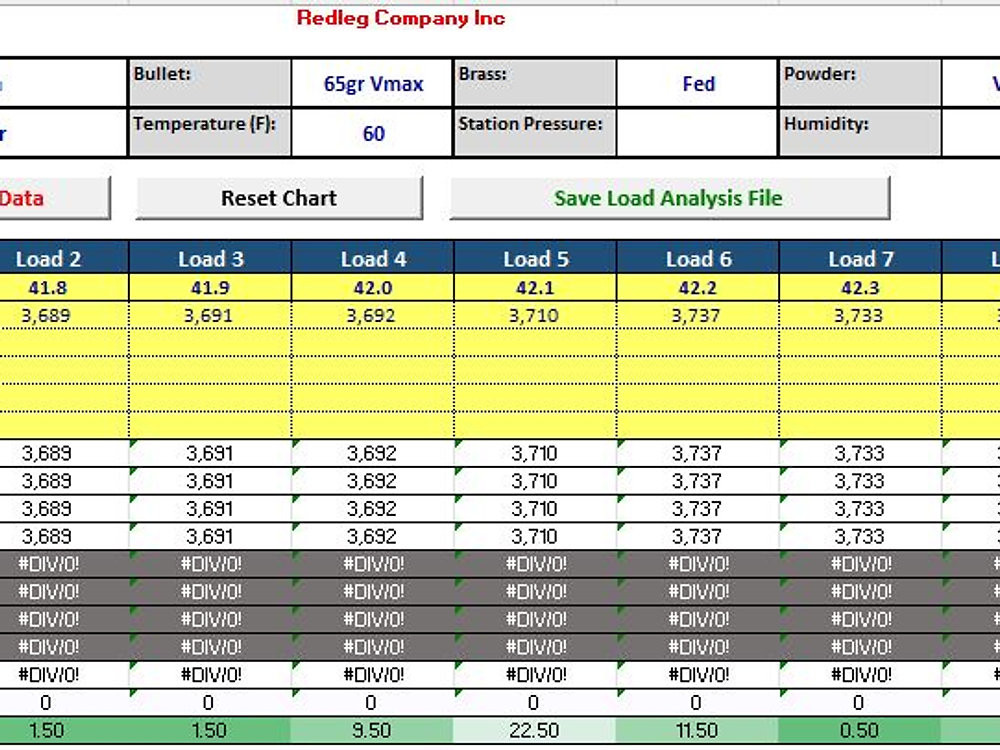
Everything in this article came off written records: the ammunition we tried, what each one grouped, the inspection numbers, and the final dope. None of it was memory. That is the whole trick, and it is not a trick.
We will send you the same reloading data sheets we use in the shop for every load we develop. Free, and it is the fastest way to stop guessing at what your rifle is actually telling you.

This rifle needed a diagnosis. The next one needed a recipe. If you want to see what happens after the rifle is right, we documented a full load development start to finish on a brand new rifle, session by session, with the targets from every one.


Comments