
What Actually Makes a Rifle Accurate? A Complete System Breakdown

Updated: 3 hours ago

Most shooters think they already know what makes a rifle accurate. You changed the ammo. It didn't help. You swapped the scope. Still inconsistent. You've put thousands of dollars into that rifle and it still won't do what it should at 300 yards. You're starting to wonder if something is fundamentally wrong with it.
Here's what we see constantly at Redleg: the rifle isn't broken. The diagnosis is.
Before you go further, if your rifle is already giving you problems, you don't have to read the whole breakdown first.
Start here: When a Rifle Suddenly SHOOTS BAD, the most common causes and how we diagnose them at Redleg.

Then come back. The system explanation below will make a lot more sense.
Most Shooters Are Solving the Wrong Problem
You changed the ammo. It didn't help. You swapped the scope. Still inconsistent. You've put thousands of dollars into that rifle and it still won't do what it should at 300 yards and you're starting to wonder if something is fundamentally wrong with it.
Here's what we see constantly at Redleg: the rifle isn't broken. The diagnosis is.
Shooters come in having already replaced barrels, stocks, and optics chasing a fix that parts can't deliver because the actual problem was never in the part they replaced. It was in the system those parts belong to. One missed bedding contact point, one inconsistent neck tension, one scope ring with uneven torque and a $4,000 rifle shoots like a $400 one.
Accuracy is not a component. It is a result. And results come from systems.
This post breaks down exactly what makes a rifle accurate all three systems, how they interact, and what happens when any one of them breaks down. It is written for the shooter who is done guessing and wants to understand the full picture.
Who This Article Is For
This is for the shooter who has already done the obvious things and the rifle still isn't performing. You're not new to this you understand the basics but somewhere between your components and your results, something is not adding up.
This is also for the hunter preparing for fall who wants to stop wondering whether their rifle is actually dialed in, or just performing well enough on a calm day at 100 yards to hide the real problems. Southwest Minnesota deer seasons expose every flaw a bench session misses.
If you're looking for a quick fix or a single upgrade recommendation, this is not that post. This is the post that explains why single upgrades usually fail and what to do instead.
Quick Answer: What Actually Makes a Rifle Accurate?
A rifle is accurate when three systems are consistent on every single shot: the mechanical system, the ammunition system, and the interface between the shooter and the environment. All three must be stable. Weakness in any one will produce inconsistent results regardless of how good the other two are.
System | What It Controls | What Breaks When It Fails |
Mechanical | Barrel, chamber, bolt, bedding, optic mount | Point of impact shifts, inconsistent groups |
Ammunition | Powder, bullet, seating depth, neck tension, velocity | Vertical stringing, flyers, ES/SD problems |
Shooter / Environment | Position, recoil, wind, temperature | Unexplained misses, result changes between seasons |
The rest of this post explains each system in depth, where they interact, and how to identify which one is causing your specific problem.
The Three Systems That Control Rifle Accuracy
System 1: The Mechanical Factors That Make a Rifle Accurate
The mechanical system is the foundation. If it is not stable, nothing built on top of it will be either. This is the one system where problems are most often misattributed because mechanical failures usually look like ammunition problems or shooter problems to someone who doesn't know what to look for.
Barrel Quality: The Foundation of What Makes a Rifle Accurate
A quality barrel provides a consistent bore diameter, uniform rifling, and predictable vibrational behavior shot to shot. The key word is consistent. A premium barrel that is improperly installed into an unstable action accomplishes little. The barrel's job is not just to guide the bullet it is to guide it the same way every time under identical mechanical conditions.

Barrel quality matters. But barrel quality without system stability is wasted money.
Chamber Geometry and Headspace
The chamber is where the cartridge lives at the moment of ignition. Its geometry determines how the brass fits, how it seals, and how the case head is supported under pressure. Headspace the distance from the bolt face to the datum line of the chamber must be within specification or pressure behavior becomes unpredictable. Even small variations in headspace produce measurable velocity inconsistency, because the ignition event begins differently each time.

Poor chamber work is one of the most overlooked causes of accuracy problems. It rarely shows up as catastrophic failure. It shows up as a rifle that "almost" shoots consistent enough to be frustrating, inconsistent enough to prevent real precision.

Bolt Lug Engagement
When the bolt closes, the lugs must contact the receiver evenly. If they don't, the bolt torques slightly under firing load. That torque introduces a variable into the ignition sequence and causes the action to behave differently under recoil.
Redleg's Bolt Lapping Process: Enhancing Rifle Accuracy,

The result is groups that never quite tighten up, no matter how well the rest of the system is tuned.
This is one of the most common mechanical issues we identify in the shop and one of the least suspected by the shooter bringing the rifle in. They've tried everything else. They haven't lapped the bolt.

Bedding and Action Stability
The action must return to the exact same position in the stock after every shot. If it moves at all even a few thousandths the barrel exits a slightly different position relative to the bore line on the next shot. The result is a point of impact that wanders unpredictably.
Pillar bedding and glass bedding solve this by creating a rigid, repeatable mechanical interface between the action and the stock. Soft stocks, worn inletting, and inconsistent guard screw torque all contribute to instability that no amount of load development will fix.
Want the full breakdown on bedding?
Pillar Bedding for Precision Rifles,

It covers exactly how bedding failure appears in group patterns and what the fix actually involves.
Scope Mounting and Alignment
Optic problems are the most commonly misdiagnosed category in precision shooting. A scope that is not properly lapped, mounted with uneven torque, or sitting in rings that introduce cant will produce results that look like a rifle problem, an ammunition problem, or a shooter problem.
Lapping Scope Rings: A Precision Shooter’s Guide to Perfect Alignment,

We have seen scopes shift point of impact between range sessions because the rings were torqued unevenly and the scope crept under recoil.

The optic does not just aim. It must remain mechanically stable through every round fired. Anything less introduces a variable that corrupts every other diagnostic effort.

System 2: The Ammunition System
A rifle cannot shoot better than the consistency of the ammunition running through it. This is the system shooters most often understand, yet most often diagnose incorrectly because ammunition problems and mechanical problems can produce nearly identical symptoms.
Bullet Jump and Seating Depth
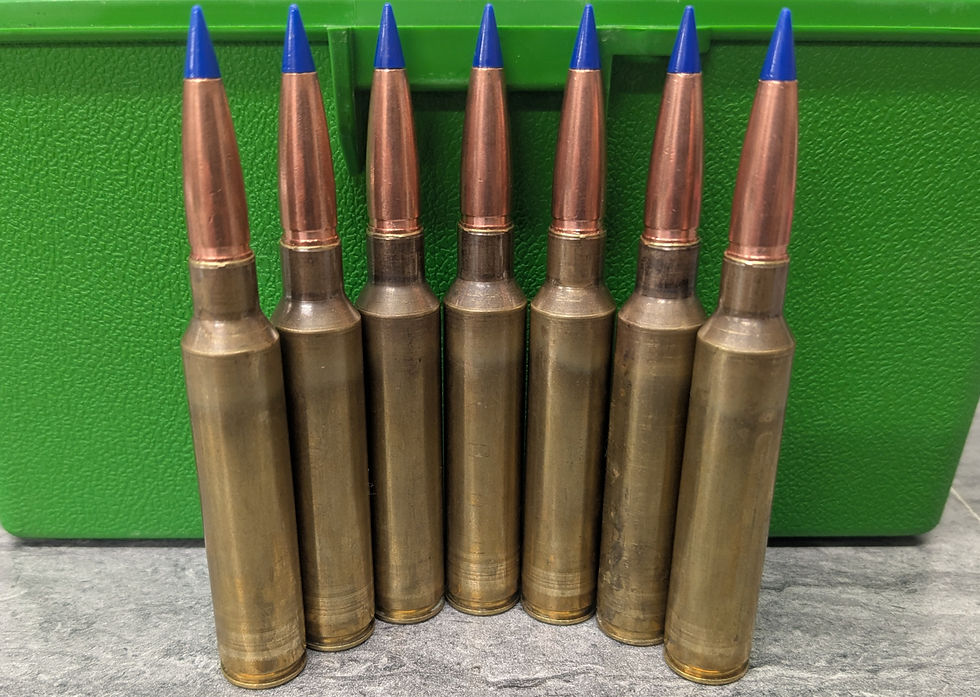
Seating depth controls the distance between the bullet's ogive and the rifling called bullet jump. This distance determines the pressure curve at the moment the bullet engages the rifling. Small changes in seating depth sometimes as little as .010" can shift point of impact and tighten or open groups significantly. Different rifles have different optimal seating depths based on chamber dimensions and barrel characteristics.
Most factory ammunition is loaded to a standard specification that is safe across a wide range of chambers, but rarely optimal for any specific one. This is why handloaded ammunition tuned to a specific rifle so consistently outperforms factory loads when done correctly.
Seating depth is one of the most impactful variables in load development.
Bullet Jump vs Seating Depth: The Complete Guide to Rifle Accuracy,

Read this before you change anything else in your load.
Powder Selection and Burn Rate
Powder burn rate determines how quickly pressure builds inside the chamber after ignition. The right powder for a given cartridge and bullet weight produces a pressure curve that peaks at the right point in the bullet's travel down the bore. The wrong powder even if it produces similar velocity generates a different curve shape that interacts with barrel harmonics differently and produces inconsistent results.
Velocity variation is the most visible downstream effect of powder inconsistency. But the root cause is the pressure curve, not the velocity number. Chasing SD numbers without understanding the underlying burn rate behavior leads to load development that optimizes for the wrong variable.

Understanding Smokeless Powder Burn Rates for Precision Reloading,

Covers how to match powder to cartridge and why burn rate matters more than most shooters realize.
Neck Tension
Neck tension is the resistance the case neck applies to the bullet before it releases. If neck tension varies from round to round due to inconsistent sizing, mixed brass lots, or varying neck wall thickness the bullet releases differently on each shot. The pressure curve shifts. Velocity changes. The result is vertical stringing that looks like a bedding problem or a scope problem but traces back entirely to the ammunition.
Brass Resizing: Chamber-Specific Control for Precision Reloading,

This is one of the most overlooked variables in handloading and one of the most common causes of frustrating inconsistency in otherwise well-tuned rifles.
SD and ES Velocity Consistency
Standard deviation (SD) and extreme spread (ES) measure how consistently a load produces the same velocity. At 100 yards, even significant velocity variation is largely invisible in group size. At 300 yards and beyond which is exactly the distance a Midwest deer hunter or precision shooter is operating at that variation translates directly into vertical dispersion. A 30 fps ES that is invisible at 100 yards can produce 3 to 4 inch vertical dispersion at 400 yards under field conditions.
Tracking SD and ES requires a chronograph and a disciplined approach to load development. It is not optional for anyone who wants to understand why their rifle performs differently at distance than it does at the bench.
Variable | What It Controls | Symptom When Wrong | Priority |
Seating Depth | Bullet entry into rifling / pressure curve | Flyers, inconsistent groups | High |
Powder Burn Rate | Pressure build rate, harmonic interaction | Velocity variation, poor nodes | High |
Neck Tension | Bullet release consistency | Vertical stringing | High |
ES / SD | Velocity consistency shot to shot | Dispersion increases at distance | Critical at 300+ yds |
Primer Consistency | Ignition uniformity | Random flyers, high SD | Medium-High |
Load development is not guessing it is a structured process.Ladder Testing vs. OCW Load Development,

This is how to find the accuracy node in your load systematically.
System 3: Rifle Harmonics
Every barrel flexes when fired. This is not a flaw it is physics. The barrel vibrates at a frequency determined by its profile, length, material, and how it is supported. The bullet exits the muzzle at a specific point in that vibration cycle. The goal is not to eliminate the vibration. The goal is to time the bullet exit consistently so the muzzle is always at the same position in the cycle when the bullet leaves.
This is why two loads can have nearly identical velocity, identical components, and identical seating depth and one shoots into a half-inch while the other opens to two inches. The difference is harmonic timing. One load exits at a node. The other doesn't.
Harmonic behavior is influenced by barrel profile, contour, the way the stock contacts or doesn't contact the barrel, the load's pressure characteristics, and temperature. It is also why a load that performs perfectly in July can open up in November the barrel's behavior changes with temperature, and a load that was at a node in warm conditions may shift out of it in cold ones.

Two loads with the same velocity can shoot completely differently. Timing is the variable most shooters never consider.
What Makes a Rifle Accurate: How the Three Systems Interact
The mechanical system, the ammunition system, and the harmonic behavior of the barrel do not operate in isolation. They interact and their interactions are where most accuracy problems actually live.
Consider this sequence: A stock with soft inletting allows the action to shift slightly under recoil. That shift changes how the barrel is supported, which alters harmonic frequency. Meanwhile, inconsistent neck tension changes the pressure curve, which changes the timing of barrel vibration. Neither problem alone would be catastrophic. Together, they produce a rifle that shoots a 1.5-inch group when both problems happen to cancel each other out and a 3-inch group when they don't.
This is why the Redleg diagnostic process evaluates the rifle as a complete system, not a list of individual components. A single-variable fix applied to a multi-variable problem produces inconsistent improvement at best and wastes money at worst.
If You See This... | The Variable Is Likely... | Where to Look |
Consistent vertical stringing | Neck tension variation or velocity spread | Ammunition system |
Groups that shift between sessions | Bedding instability or optic mount | Mechanical system |
Load that worked, now doesn't | Harmonic shift (temperature) or brass fatigue | Harmonics + Ammo |
Flyers with no pattern | Ignition inconsistency or primer variation | Ammunition system |
Point of impact shifts under recoil | Scope mount, bolt lugs, or bedding | Mechanical system |
Accuracy degrades at distance only | High ES/SD velocity inconsistency | Ammunition system |
What Most Shooters Get Wrong
Authority Spike #1: A premium barrel installed in an unstable action will never outperform a standard barrel in a properly bedded one. The foundation matters more than the component on top of it.
Authority Spike #2: Most rifles don't need better parts. They need correct diagnosis. We see $5,000 builds that won't group not because the components are wrong, but because no one ever evaluated the system those components are part of.
Authority Spike #3: Load development cannot fix a mechanical problem. We watch shooters spend months developing loads trying to tune around an unstable action or uneven bolt lug contact. The load is not the variable. Fix the rifle first.
The Most Common Mistakes We See
Replacing Parts Instead of Diagnosing Systems
This is the most expensive mistake in precision shooting. A shooter whose rifle won't group tries a new barrel. It helps a little. Then a new stock. That helps too. But the rifle still doesn't shoot the way it should because the underlying problem was bedding instability, and every part change slightly redistributed the problem without solving it. A proper diagnostic before the first dollar is spent on parts would have identified bedding as the issue and saved several hundred dollars minimum.
Changing Multiple Variables Simultaneously
You changed the powder, the seating depth, and the primer in the same test session. The group improved. Now you don't know which change caused the improvement and you can't reproduce it reliably because you don't know what you're actually measuring. Systematic load development changes one variable at a time. Everything else is noise.
Assuming Bench Performance Equals Field Performance
A bench at a range eliminates nearly every environmental variable a field shooting situation introduces. The same rifle that shoots a 0.6-inch group on a calm morning at 100 yards may produce 2.5-inch dispersion at 350 yards in a 15-mph southwest Minnesota crosswind with a 25-degree temperature drop from morning to afternoon. Bench performance tells you the floor of what the rifle can do. Field conditions determine whether it can actually deliver that performance when it matters.
Misidentifying Vertical Stringing as a Bedding Problem
Vertical stringing is consistently blamed on bedding. Sometimes it is. More often it traces to neck tension variation or velocity spread. The diagnostic process matters because treating a neck tension problem with a bedding job wastes time, money, and a season of hunting prep. The symptom is the same. The fix is completely different.
What Happens If You Ignore This
In the short term, nothing catastrophic. Your rifle will continue to perform somewhere below its potential. You'll continue adjusting your hold, compensating with your position, or attributing the inconsistency to conditions. It feels manageable.
In the field, it doesn't feel manageable. A 300-yard shot on a mature whitetail in a 12-mph Midwest crosswind does not allow for the kind of margin that hides a system problem. The difference between a clean harvest and a wounded deer at that distance is often a 2-inch variance in point of impact exactly the kind of variance a bedding issue, an inconsistent load, or a scope mounting problem produces on demand.
Long-term, the financial cost of ignoring system problems is significant. Shooters who chase parts instead of diagnosing systems routinely spend $1,500 to $3,000 on upgrades before someone finally looks at the whole picture and identifies a $300 fix. We see this every spring when hunters start preparing for fall and bring in rifles that have been frustrating them for two or three seasons.
How to Diagnose Your Rifle Accuracy Problem
Start with structure. Accuracy problems are solved through elimination not guessing, not part replacement, not asking the internet what someone else's rifle did.
Step 1: Verify Mechanical Stability
Check bedding, guard screw torque, and optic mount before touching ammunition. If the mechanical foundation is not stable, no load development result is valid. You are testing a moving target.
Step 2: Establish a Velocity Baseline
Chronograph your current load. Record SD and ES across at least 10 rounds. If your ES is above 30 fps, fix the load before evaluating groups. Vertical dispersion at distance is almost entirely a velocity problem.
Step 3: Isolate One Variable
Change one thing. Test it. Measure the result. Change one more thing. This process feels slow. It is the only process that produces actionable data. Multi-variable changes produce confusing results and untraceable improvements.
Step 4: Test Under Real Conditions
Validate at distance 200 yards minimum, 300+ preferred for anything being used for hunting or precision work. Bench performance at 100 yards is a starting point, not a conclusion.
What This Looks Like in the Real World
The Hunting Scenario
It's April in southwest Minnesota. Deer season is six months out which sounds like plenty of time, but it isn't if you're starting the diagnostic process in October. You have a rifle that groups around an inch at 100 yards. That sounds fine until you run the math at 350 yards with a 15-mph quartering wind and a cold rifle that sat in the truck for two hours. That 1-inch bench group becomes a 3 to 4-inch dispersion zone in field conditions. The difference between a clean shot and a poor hit is often buried in an ammunition system that was never properly tuned, or a bedding job that was never done at all.
Spring is the time to find this. Not October. The shop has availability now. The diagnostic process takes time. The fixes take time. By the time hunting season arrives, you want a rifle that you've confirmed performs correctly not one you're hoping performs correctly.
The Precision Shooting Scenario
At 100 yards, most rifle problems are invisible. Groups look acceptable. The shooter feels confident. At 500 yards, the same rifle exposes every flaw in the system velocity inconsistency produces vertical, bedding instability produces random POI shifts, harmonic problems produce groups that are good one string and open the next. The precision shooter who wants to perform consistently at distance has to build from the mechanical foundation up. There are no shortcuts that survive 500 yards.
The Reloading Scenario
Reloaders often blame the rifle for problems that live in the load, and blame the load for problems that live in the rifle. The most common version: a shooter develops a load, it shoots well for a while, then opens up. They change powder, change primer, change seating depth. Nothing fully fixes it. The actual problem is brass fatigue cases that have been fired too many times and have inconsistent neck tension across the lot. The mechanical system is fine. The ammunition system degraded. Diagnosing which system owns the problem is the entire difference between fixing it efficiently and wasting months on the wrong variable.
Where to Start: A Decision Framework
If you are not sure which part of your rifle system is causing your accuracy problem, use this sequence:
Symptom | Most Likely System | First Action |
Groups shift between sessions | Mechanical | Check bedding + optic torque |
Consistent vertical stringing | Ammunition | Chronograph, check ES/SD |
Random flyers, no pattern | Ignition / Ammunition | Check primers + neck tension |
Accurate at 100, poor at 300+ | Ammunition (velocity) | Measure ES, develop load at distance |
POI shifts after recoil sequence | Mechanical | Check scope mount + bolt lugs |
Load worked, now doesn't | Harmonics + Brass | Check brass fatigue + temp conditions |
What We Consistently See at Redleg
Every spring, we see the same pattern. A shooter brings in a rifle that has been frustrating them. They've replaced the barrel. Maybe the scope. They've tried three different factory loads and two handloads. The rifle "almost" shoots good enough to keep hoping, inconsistent enough to keep being a problem.
In most of those cases, the mechanical system was never properly evaluated. The bedding was original. The bolt lugs had never been lapped. The scope rings had been torqued by feel. Nothing was broken. Nothing was obviously wrong. But nothing was properly fitted either and precision rifles require proper fitting, not just quality components.
The other pattern we see: excellent handloaders who have been developing loads in a rifle that has a bedding problem. Every load they test is being tested on an unstable platform. Their data is real but it is data for a broken system, not a functional one. When we stabilize the mechanical system first, they often find that loads they rejected as "too inconsistent" were actually quite good the inconsistency was in the rifle, not the load.
The diagnosis always comes before the fix. That is the Redleg standard.
If your rifle isn't performing the way it should there's a reason. It's almost never what you've already tried to fix. At Redleg, we evaluate the complete system: mechanical integrity, ammunition consistency, and harmonic behavior. We don't guess. We diagnose.
507-677-6007
Which article brought you here? Let us know when you reach out.
A Note on System Failures and Safety
Most accuracy system problems are performance issues, not safety issues. But there are mechanical conditions where the line between inconsistency and unsafe operation is closer than it appears. Significant headspace problems, cracked or fatigued brass being fired in a rifle with a rough chamber, and improper scope mounting that allows the rifle to be handled carelessly can all create conditions where what looks like an accuracy problem is actually a developing safety problem.
If your rifle is producing signs of excessive pressure sticky bolt lift, flattened or cratered primers, case head separation stop shooting it. Those are not accuracy symptoms. Those are pressure symptoms, and they require professional evaluation before the rifle is fired again. The consequences of ignoring them are not a bad group they are structural failure under load.
Frequently Asked Questions
What is the single most important factor in rifle accuracy?
There is no single factor and that answer is the point of this entire post. Accuracy is a system result. The most important factor is whichever one in your specific rifle is currently the limiting variable. A rifle with excellent ammunition but a loose scope mount is limited by the scope mount. A rifle with solid mechanics but 45 fps ES is limited by velocity inconsistency. Identifying the limiting variable is the job of diagnosis, not assumption.
Can factory ammo produce accurate results?
Yes within limits. Quality factory ammunition from premium manufacturers is loaded to consistent specifications and will produce good results in many rifles. But factory ammunition is designed to function safely across a wide range of chamber dimensions, which means it is rarely optimized for any specific rifle. At 100 yards the difference is modest. At 300+ yards, a handload tuned to your rifle's specific dimensions and harmonic node will consistently outperform factory ammunition in the same rifle.
How do I know if my bedding is causing my accuracy problem?
The clearest symptom of a bedding problem is point of impact that shifts between sessions especially if groups are consistent within a session but different the next time the rifle is shot. Another indicator is groups that tighten up after the rifle "settles in" through several shots, then open again after a cold start. If you can visually rock the action in the stock, the bedding is definitively the problem. If you can't see movement but groups behave inconsistently, a professional evaluation is the right next step.
Why does my rifle shoot differently in cold weather?
Temperature affects powder burn rate, which shifts the pressure curve, which changes velocity and harmonic timing. A load that sits at a harmonic node at 70 degrees may be off-node at 20 degrees because the barrel's vibrational behavior changes with temperature and the load's pressure characteristics change simultaneously. This is why loads developed exclusively in summer often disappoint during fall hunting season. Testing in conditions representative of actual use is not optional for serious field rifles.
Is vertical stringing always a bedding problem?
No and this is one of the most common misdiagnoses we see. Vertical stringing is most often caused by velocity variation (high ES/SD), inconsistent neck tension, or barrel/stock contact issues. Bedding problems more commonly produce horizontal or diagonal stringing, or groups that shift position between sessions rather than stringing vertically within a session. Treat the symptom after identifying the correct system not based on the most commonly suggested answer.
How many rounds does it take to develop a good load?
A proper load development process using ladder testing or OCW methodology requires a minimum of 40 to 60 rounds to generate valid data across a meaningful range of variables. Attempts to shortcut this with 10-round tests produce data that looks like conclusions but isn't. The investment in components and range time to develop a load properly is small relative to the value of actually knowing what your rifle is doing and why.
When should I bring my rifle to a gunsmith vs. continuing to work on it myself?
The answer is earlier than most shooters do it. If you have eliminated ammunition variables through systematic testing and the rifle still produces inconsistent results, the problem is mechanical and mechanical problems in precision rifles require the equipment and experience to diagnose correctly. Coming to the shop after six months of trying other things is common. Coming in after two weekends of structured testing is better. The diagnostic process is faster and less expensive when the record of what has already been tested is clean.
Does a more expensive barrel make a rifle more accurate?
Up to a point, and then it stops mattering relative to everything else. A quality barrel from a good maker is a real advantage over a mass produced one. A very expensive barrel in a rifle with a stressed action and a poor mount will not outshoot a moderate barrel in a rifle that is set up correctly.
How accurate should a factory rifle be?
Most modern factory hunting rifles will shoot roughly an inch to an inch and a half at 100 yards with ammunition they like, which is more than enough for their job. If yours is well outside that with several different loads, something is wrong rather than merely ordinary.
Does bedding matter on a chassis rifle?
Less than on a wood or injection molded stock, because a chassis is already rigid and machined to fit. It is not automatically zero. Fit still varies, and an action that does not sit square in a chassis has the same problem an action in a bad stock has. Check it rather than assume it.
How much of rifle accuracy is the shooter?
More than most people want to hear, and it is the cheapest thing on this list to improve. Handing the rifle to another competent shooter with the same ammunition is the fastest diagnostic available, and it resolves a large share of the accuracy complaints that come through the shop.
Is a heavier barrel more accurate?
A heavier barrel is more forgiving, which usually shows up as accuracy. It heats more slowly, it is stiffer, and it damps vibration better, so it holds its group through a longer string. A light barrel can shoot just as well cold. It simply has less margin.
Where should I start if I can only fix one thing?
With whatever is measurably wrong, not with whatever is most expensive. Check mount and ring torque, check that the action screws are at spec and even, check that the barrel is free floated, and shoot a different ammunition lot. Those four cost nothing and they catch most of it.
What to Read Next
Now that you understand how the three systems interact, the next question most shooters get wrong is this: which system is actually causing their specific problem? The most common mistake is assuming it's the ammunition because that's the variable shooters have the most control over. But when the mechanical system is unstable, no load will ever be consistent. Here's exactly what to check first, and how to tell whether what you're seeing is a rifle problem or a load problem: When a Rifle Suddenly SHOOTS BAD,
Spring is the right time to do this work. Deer season prep in October is too late to fix a rifle that needs bedding, bolt lapping, or a proper load development baseline. Redleg offers precision accuracy diagnostics, bedding, chamber work, barrel threading, and custom builds. Shop availability is better now than it will be in August.
507-677-6007
Chandler, MN
Which article brought you here? Tell us when you reach out.
Go Deeper: Each System Has Its Own Breakdown
This post covers the complete framework. Each sub-topic below has its own full technical breakdown. Use these when you're ready to go from understanding the system to diagnosing and fixing a specific part of it.
Bedding and Mechanical Stability
You now know that bedding instability is one of the most common and most misdiagnosed sources of accuracy problems. Most shooters who have never had a proper bedding job done don't know what they're missing because their rifle shoots well enough to mask the problem at short distances. The full breakdown covers exactly how bedding failure shows up in group patterns, what pillar bedding actually does mechanically, and what the process looks like at the shop.
Pillar Bedding for Precision Rifles,
Bullet Jump and Seating Depth
Seating depth is the ammunition variable with the most direct mechanical impact on accuracy and the one most handloaders set once and never revisit. Even small changes in how far the bullet sits from the rifling can shift groups significantly. The full guide covers the physics of bullet jump, how to find your rifle's optimal seating depth, and why what works in one rifle often doesn't transfer to another.
Bullet Jump vs Seating Depth: The Complete Guide,
Powder Burn Rate and the Pressure Curve
Most shooters select powder based on what others recommend for their cartridge. That is a starting point, not an answer. Powder selection for a precision rifle involves matching burn rate to barrel length, bullet weight, and the harmonic characteristics of that specific rifle. The full guide covers how to evaluate and select powder correctly and why two powders with similar velocity numbers can produce completely different accuracy results.
Understanding Smokeless Powder Burn Rates,
Load Development: Finding the Node
Understanding that harmonic timing matters is one thing. Knowing how to systematically find the load that puts your bullet at the right point in the barrel's vibration cycle is another. Ladder testing and OCW methodology are the structured approaches to this and they produce real data instead of informed guessing. The full breakdown covers both methods, when to use each, and how to read the results.
Ladder Testing vs. OCW Load Development,
Vertical Stringing: Diagnosing the Cause
Vertical stringing is the symptom shooters most often misattribute. It gets blamed on bedding when it's usually a velocity problem, blamed on the load when it's often a neck tension problem, and blamed on the shooter when the rifle is producing it mechanically. The full breakdown covers every cause of vertical stringing with the diagnostic steps to identify which one you're actually dealing with.
Why Your Rifle Is Stringing Vertically,

Inconsistent Velocity: Finding and Fixing the Root Cause
High ES and SD are symptoms. The root cause lives somewhere in the ignition and ammunition system, and finding it requires a systematic approach, not component swaps. The full breakdown covers every variable that produces velocity inconsistency, from primer sensitivity to case volume variation, and how to isolate and correct each one.
Inconsistent Velocity Killing Accuracy,

If you've been managing a rifle that almost performs the way you want it to and you're tired of almost a properly built precision rifle starts with the system right and never makes you wonder what's causing the problem. Spring is Redleg's best availability window for custom builds. By the time fall prep season hits, the shop fills up fast.
507-677-6007
Which article brought you here? Tell us when you call.
Download Redleg Reloading Data Sheets
If you are serious about improving rifle accuracy, you need to track your data.
Our reloading sheets help you track:
velocity
seating depth
powder charges
group size


Final Thoughts
You came into this post thinking accuracy was about finding the right component. You're leaving it knowing it's about finding the right variable and that the variable is always inside a system.
The shooter who understands this builds rifles that perform consistently. The shooter who doesn't keeps replacing parts and wondering why the groups don't tighten up. We see both types in the shop every week. The difference in outcome is almost always the quality of the diagnosis before any money is spent.
Most accuracy problems are fixable. Most of them are not in the component the shooter is looking at. And most of them become obvious quickly once the complete system is evaluated correctly.
If you're serious about fixing this the right way not guessing reach out.
507-677-6007 info@redlegguns.com
Wondering whether a full custom build is the answer to your accuracy problem? Read Custom Rifle Accuracy: A Custom Rifle Won't Fix Your Aim, but It Will Remove the Excuses for the honest breakdown of what a custom rifle does and does not fix.
Last updated: April 2026 | Data based on rifles built, tested, and diagnosed by Redleg Company, Chandler, MN.


Comments