
When a Rifle Suddenly SHOOTS BAD (Why my rifle won’t group)

Updated: Sep 21
A rifle that shot well last season and does not now has almost never worn out its barrel. Barrels fade over hundreds of rounds. They do not quit between one range trip and the next. Something changed, and the order to check it in is fixed: the shooter, then the ammunition, then the optic and its mounts, then the conditions, and only then the rifle itself. Work it in that order and most problems are solved before you spend a dollar. Work it backwards and you buy a barrel to fix a loose ring screw.
Why My Rifle Won't Group: Start Here
You’re at the range. Heart rate steady. Dope dialed. Wind checked.
First shot perfect. Second shot still good. Then the group opens up like a shotgun pattern.
Frustration hits.

“Barrel’s shot out,” you mutter already pricing replacements, scopes, maybe a new stock.
Stop.
Most rifles don’t die overnight. Something changed and 9 times out of 10, it’s not the barrel.
At Redleg, we’ve seen shooters waste thousands of dollars chasing the wrong problem. That’s why we built this system a top-down diagnostic flowchart that isolates the real cause before you change anything. This is the exact process we use in the shop. No guessing. No money traps. Just answers.
The Redleg Diagnostic Flowchart Your Roadmap to Truth

Now let’s break it down the same way a professional gunsmith does.
Step 1: The Shooter - You’re Usually the Weak Link (And That’s Fixable)
Here’s the hard truth:
Even a $10,000 custom rifle can’t outshoot bad fundamentals.
Common accuracy killers we see every week:
Inconsistent cheek weld or shoulder pressure → barrel whip chaos
Trigger slap → instant vertical stringing
No follow-through → head lift = point-of-impact shift
The Fastest Test We Know
Hand the rifle to a trusted shooter with solid fundamentals. Same ammo. Same conditions.
If their groups shrink dramatically, the rifle is innocent.
That single test ends 40% of our diagnostic calls.
Fix it fast:
Dry fire with intent
Video yourself shooting (side angle)
Focus on smooth trigger press and staying in the rifle until impact
Do not touch screws, optics, or torque yet. You’re still establishing a baseline.
Which rifle it is matters less than most shooters think, but if you are picking one for deer season:

Step 2: The Ammo - Inconsistent Fuel = Inconsistent Results
Ammo changes far more often than shooters realize.
New factory lot
Slight powder change
Neck tension off
Seating depth drift
Even “match” ammo isn’t immune.

Do this before blaming the rifle:
Shoot a fresh box of proven match ammo (Federal GMM, Hornady Match, etc.)
Chronograph your shots
If SD is over ~20 fps, accuracy will suffer period
Reloaders:
Weigh charges
Verify neck tension
Confirm seating depth consistency
If groups tighten, congratulations you just saved a barrel job.
If the ammunition turns out to be the variable, this is what disciplined load work actually looks like:

Step 3: The Optic - The Silent Group Killer
We see this weekly:
“The barrel’s toast. ”Reality: a loose ring screw.

Inspect in this order:
Torque base and ring screws to manufacturer spec (with a real torque wrench)
Look for scope tube movement or ring marks
Lightly tap the turret housing reticle should not shift
The Killer Test
Swap in a known-good scope.
If the rifle groups again, the optic was the villain not the barrel.

And if the rings themselves are the problem, this is how they get fixed rather than replaced:

Step 4: The Environment - Blame Physics, Not the Gun
Wind and mirage lie to shooters constantly.
A 5 mph crosswind can move a .308 4 to 6 inches at 300 yards
Hot-barrel mirage distorts the sight picture
Bipod on concrete ≠ bags on dirt
Control what you can:
Log wind, temperature, and mirage
Let the barrel cool between groups
Retest on a calm day or indoors
Step 5: The Rifle - Only Now Do We Go Mechanical
Now we inspect the rifle itself.
Mechanical Checklist (In Priority Order)
Action Torque Uneven torque induces stress. Stress kills consistency.
Stock Contact & Bedding If the barrel touches the stock under recoil or loading, accuracy dies fast.
Bolt Lug Contact Uneven lug engagement flexes the action differently every shot.
Chamber & Throat Carbon rings, erosion, or misalignment are common especially in higher-round-count rifles.
Crown One small ding or burr will destabilize bullets instantly.
This is where most “mystery accuracy problems” actually live.
Each item on that checklist has its own article. Action stress and bedding:
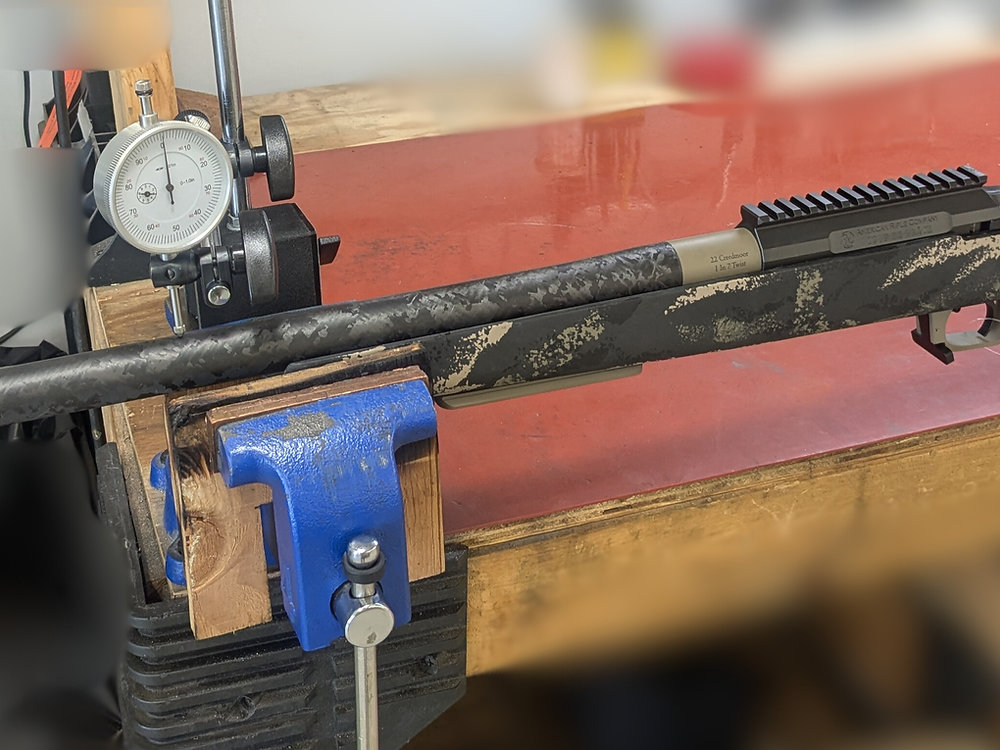
Lug contact, and the marker test that shows you in two minutes whether both lugs are carrying load:

Vertical stringing specifically, which has its own short list of causes:

What NOT to Touch (Yet)
Don’t rebarrel barrels wear gradually, not overnight
Don’t re-zero between steps you’ll erase patterns
Don’t start adjusting triggers or turrets mid-diagnosis
Changing parts without diagnosis is how shooters burn money.
The Expensive Mistakes We See Every Week
New scope on loose rings → $1,000 wasted
Rebarrel to fix a loose action screw → $1500 gone
Blaming ammo without chrono data
Ignoring shooter error because “I’ve been shooting for 20 years”
Follow the order. Save the cash.
When You’ve Done It All - Call the Pros
If you’ve worked through the entire flowchart and the rifle still won’t group, it’s time for precision instrumentation.
At Redleg, we don’t guess.
Our diagnostic service includes:
Chamber and bore alignment measurement
Lug contact and bedding stress analysis
Digital torque verification
Crown and throat inspection
Data-backed recommendations
Most clients save money because we find the $20 problem before they buy the $2,000 solution.
Why This System Works
Because it’s not opinion. It’s physics, alignment, pressure, and repeatability.
Accuracy isn’t a mystery it’s a process.
And once you understand the cause, the fix is usually simple and permanent.
The Two Barrel Problems People Confuse
Sudden is carbon. Gradual is wear.
A carbon ring builds quietly at the throat and then hits a tipping point. Pressure spikes, seating depth sensitivity goes strange, groups fall apart in what feels like a single afternoon. It gets diagnosed as a dead barrel constantly, and it comes out with solvent and the right brush in half an hour.

Real wear looks different. Velocity walks down over hundreds of rounds, groups open slowly, and a chronograph sees it long before your target does. If you are 150 to 200 fps off where the barrel started and still dropping, that is a barrel. Nothing else on this list produces that curve.

Frequently Asked Questions
Why did my rifle suddenly stop grouping?
Something changed, and it is rarely the barrel. In order of how often we find it: shooter fundamentals, an ammunition lot change, a loose base or ring screw, a scope that has failed internally, and then the rifle's mechanical fits. Barrels wear gradually over hundreds of rounds. They do not fail between two range trips.
Is my barrel shot out?
Probably not, and it is the most expensive wrong answer available. A shot out barrel shows a slow velocity decline you can see on a chronograph, usually 150 to 200 fps off its original number and still dropping, with groups that opened gradually rather than overnight. If your rifle was fine last month, look elsewhere first.
What is the first thing I should check?
Hand the rifle to another competent shooter with the same ammunition in the same conditions. If their groups are dramatically better, the rifle is fine and you have saved yourself a lot of money. It is free, it takes ten minutes, and it ends a large share of the diagnostic calls we get.
Could it just be the ammunition?
Very often, yes. A new factory lot, a powder change the manufacturer did not advertise, drifting neck tension or seating depth in handloads: any of these will open a group. Shoot a fresh box of proven match ammunition before you touch anything on the rifle.
How do I know if my scope is the problem?
Torque the base and ring screws to spec with a real torque wrench, look for ring marks that show the tube has moved, and tap the turret housing lightly to see whether the reticle shifts. Then swap in a scope you know is good. If the rifle groups again, you had your answer and it was not the barrel.
How much can wind actually move my group?
More than most shooters credit. A 5 mph crosswind will push a .308 four to six inches at 300 yards. Mirage off a hot barrel distorts the sight picture on top of that. Retest on a calm day before concluding anything mechanical.
Should I re zero between diagnostic steps?
No. Re zeroing erases the pattern you are trying to read. Leave the zero alone until you have found the cause, then zero once at the end.
What is action screw torque supposed to be?
Follow the action manufacturer's number, and use a torque wrench rather than feel. Uneven torque induces stress in the action, and stress produces inconsistency that looks exactly like an accuracy problem. Torque both screws to the same value, in the same order, every time.
Can a carbon ring make a rifle stop grouping suddenly?
Yes, and it is the one failure on this list that genuinely arrives overnight. Carbon builds slowly at the throat until it hits a tipping point, then pressure and seating sensitivity change together and the groups go. It is regularly misdiagnosed as a worn barrel.
What if the stock is touching the barrel?
Then it will change point of impact as you load the bipod, as the barrel heats, and as pressure on the fore end changes. Slide a dollar bill down the barrel channel. If it stops, the barrel is in contact somewhere it should not be.
How much does a diagnostic cost at Redleg?
Call the shop at 507-677-6007 or check the services and pricing page for the current figure. The point of the service is that it is a fraction of what a barrel costs, and it very often ends with us telling you not to buy one.
Can you diagnose a rifle if I ship it to you?
Yes. Rifles come to us from across the country and we ship everything back when the work is complete. Send the rifle with the ammunition it is not grouping with, and a target or two if you have them, because the group pattern itself carries information.
What if I have done everything on this list and it still will not group?
Then it is time for instrumentation rather than more guessing: chamber and bore alignment measured on an indicator, lug contact and bedding stress checked, torque verified digitally, crown and throat inspected. That is what a bench diagnostic is for and it is where we find the causes a range session cannot.
Should I rebarrel before hunting season if I am not sure?
No. A new barrel needs load development and a zero, which is the last thing you want to be doing in October. Diagnose first. If the barrel really is done, you will know in time, and if it is not, you have kept a rifle you already trust.
My rifle shoots one good group and then opens up. What is that?
Usually heat, and usually the stock rather than the barrel steel. A barrel that touches the stock cold may bind against it hot. Let the barrel cool fully between groups and retest. If cold groups are good and hot groups are not, that is a bedding and contact conversation, not a barrel conversation.
Send Us the Rifle
If you have worked the list and the rifle still will not group, that is exactly what our diagnostic service is for. Call 507-677-6007 or start from the services and pricing page. Rifles ship to us from across the country and we ship everything back when the work is complete.
Redleg Company, 430 Main Avenue, Chandler, Minnesota. Phone 507-677-6007. Email info@redlegguns.com.
The whole accuracy system, in order of how much each part actually moves a group:


And what this diagnostic looks like start to finish on one real rifle, where the answer turned out not to be the barrel:

Want a clean place to log your shooting and load data? Our free reloading sheets are here.


Comments