
3,777 FPS from a .243 AR-10: Twist Rate, Gas, and a Barrel That Never Came

Updated: 3 days ago
He did not ask for a faster twist. He asked for lighter bullets.
That one sentence decided most of this build. It is also the opposite of where the industry has drifted, and it is worth explaining, because twist rate is the specification most people copy from a forum instead of choosing on purpose.

The barrel that never showed up
The honest part of this job comes first. The original barrel for this rifle was ordered from one maker and it never arrived. It went 63 days past its own estimated date with no tracking and no reply, and at that point it stopped being a delay and started being a decision.
We called the owner, explained where it stood, and got approval by phone to change the source. The replacement is a Proof Research AR-10 carbon fiber barrel, .243 Winchester, 22 inches, 1-10 twist. It came through a distributor who had it on the shelf and it shipped the same week.
We mention this because build blogs usually skip it. Parts do not always arrive. What matters is whether the shop tells you early and gives you a real choice, or lets the job sit quietly for two months.
Why 1-10 and not a faster twist
Twist rate is not a quality setting. A faster twist is not a better barrel. Twist exists to stabilize a bullet of a particular length, and bullet length tracks weight within a caliber.
Pick the twist for the bullet you intend to shoot.
The .243 Winchester has been pulled steadily toward fast twists over the last decade because heavy, high-BC 105 to 115 grain match bullets are fashionable and they need a 1-7.5 or 1-8 to stabilize. That is the right call if you are shooting those bullets.
This owner is not.
He told us plainly that he wanted to shoot light and fast. Varmints and predators, flat trajectory, explosive terminal effect. That is 55 to 70 grain territory, and those bullets are short. A 1-10 stabilizes them comfortably, and it does something a faster twist does not: it spins them slower at the same velocity.
That matters more than it sounds. Thin-jacketed varmint bullets driven very fast in a very fast twist can come apart in flight from rotational stress. Matching a moderate twist to a light bullet is how you get the velocity without the surprise.
If you are choosing a twist for a .243 of your own, this is the practical version. It is a guide rather than gospel, because bullet length rather than weight is what actually decides stability, and a long copper monolithic will need more twist than a lead core bullet of the same weight.
Bullet weight | Typical use | Twist that works |
55 to 60 gr | Varmints, high volume, maximum velocity | 1-12 to 1-10 |
65 to 70 gr | Varmints and predators, a little more wind | 1-10 to 1-9 |
75 to 80 gr | Predators, light deer | 1-9 |
85 to 90 gr | Deer, general purpose | 1-9 to 1-8 |
95 to 105 gr | Deer, target, longer range | 1-8 |
105 to 115 gr | High BC match, wind performance | 1-8 to 1-7.5 |
Read that table from the left. Decide the bullet, then read across. Doing it the other way round, picking a twist and then finding out what it will shoot, is how people end up with a fast twist barrel and a shelf of 58 grain bullets it overspins.

The other problem with a .243 in an AR-10
The .243 Winchester is a .308 case necked down. It burns a .308-sized powder charge behind a six millimeter bore, which means it produces a large volume of gas relative to the hole that gas has to escape through.
Put that in a gas gun built and ported around .308 Winchester and the rifle is over-gassed. The bolt unlocks early and violently. Brass gets thrown thirty feet and lands dented. Extraction happens while pressure is still high, which is hard on cases and hard on the rifle. Felt recoil goes up for no benefit at all.
Then add a suppressor, and every bit of it gets worse. A can raises back pressure, which sends more gas back down the tube and more of it out of the ejection port and into the shooter's face.

Fix it at the source, not at the buffer
The common answer to an over-gassed AR is a heavier buffer and a stiffer spring. That is treating a symptom. You are still dumping too much gas into the system and then trying to absorb the result at the back of the rifle.
The better answer is to meter the gas where it enters. This build uses an adjustable gas block, tuned to the actual load with the suppressor fitted, so the rifle gets exactly the gas it needs to cycle reliably and nothing more.
Tuned properly the difference is obvious in the hand. Brass lands in a tidy pile a few feet away instead of across the next bay. The rifle tracks flatter, so you see your own impact. And the gas that used to come back at your face largely stops.
One caveat, said out loud: a gas system tuned with a suppressor on is tuned for that configuration.
Take the can off and the rifle may short stroke until you open the block back up. That is not a fault, it is the trade you accept for a rifle that runs properly suppressed. If you shoot it both ways, note both settings.
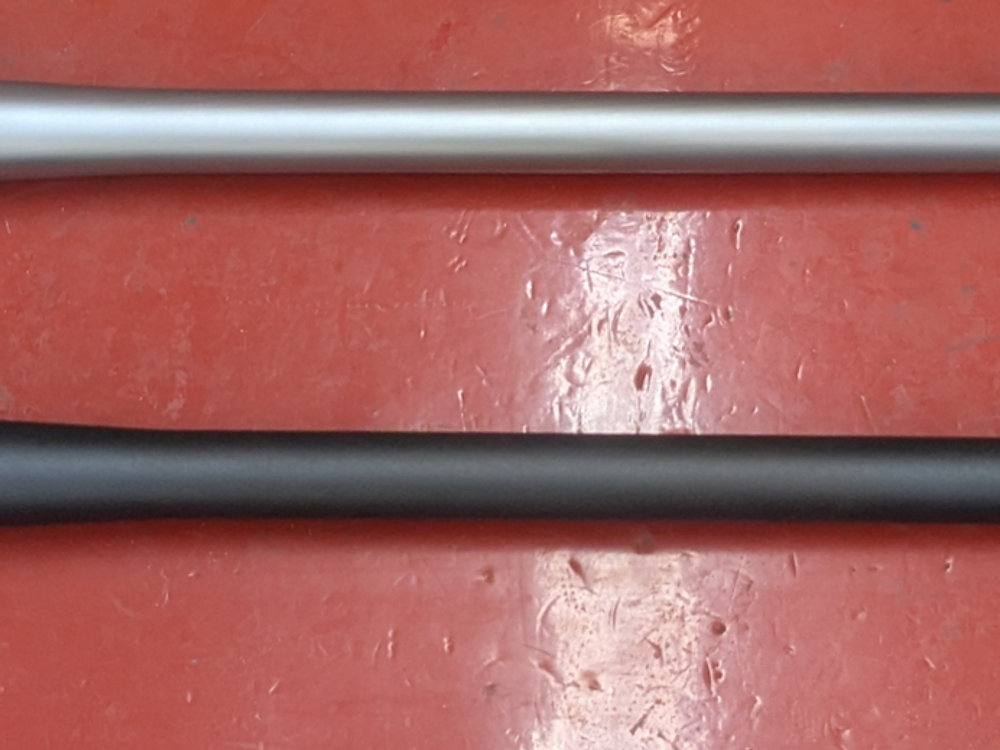
The rest of the build
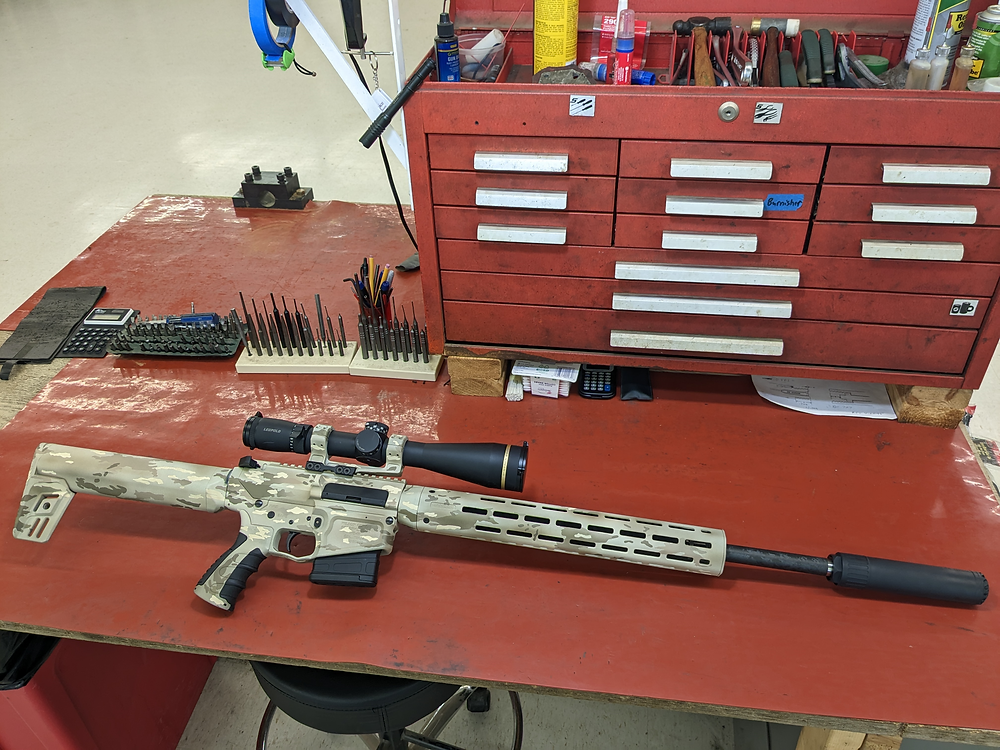
The host is a JP Enterprises LRP-07, which is a serious large-frame platform to start from. It got a TriggerTech AR Diamond trigger, a B5 Systems SOPMOD stock, a threaded muzzle for the suppressor and the adjustable gas block already described.
The optic is the shop's own Burris. We use this scope when the build is not getting an optic.
The tiger stripe Cerakote is our work, done in house. That finish took just under six hours of hand masking and spraying, which is most of a working day and is why a multi-color pattern is priced the way it is.

3,777 feet per second and 0.39 MOA, on factory ammunition
The load in the photograph is not a handload. It is Hornady Superformance Varmint, 58 grain V-MAX, item 8343, straight out of the box. At 100 yards, suppressed, it chronographed at 3,777 feet per second.
That is genuinely fast for a factory .243 out of 22 inches, and it is the twist decision paying off. A light bullet, a moderate twist that does not overspin it, a barrel that shoots, and a gas system that is not fighting the rifle.
It is also a reminder worth repeating: a rifle that shoots well on factory ammunition is a rifle you can actually use. Not everyone reloads, and a build that only performs with a bespoke load is a build with a leash on it.
It also shot 0.413 inches at 100 yards. That is 0.39 MOA, on factory ammunition, out of a semi-automatic, with a can on it.
Sub half minute out of a gas gun is worth pausing on, because a semi-automatic has to do things a bolt gun does not. It cycles, it unlocks under pressure, it moves mass around while the bullet is still in the barrel. A great many AR-10s in .243 shoot one and a half to two minutes and their owners consider that normal for the platform.
This one did not, and the reasons are the same ones the rest of this article is about. A barrel with a chamber cut true to the bore. A twist matched to the bullet rather than overspinning it. And a gas system metered so the rifle is not fighting itself while the bullet is still on its way out.
The honest caveat: that is one group on one day, and one group is a data point rather than a guarantee. What it tells you is what the rifle is capable of, not what it will do every time in any conditions with any lot of ammunition. We would want to see it repeat across a few sessions before calling it a half minute rifle in writing.
The dope card that goes home with it
Every rifle that leaves this shop leaves with one of these. Chronographed velocity, a confirmed zero, and elevation and wind written down so the owner is not guessing on the first cold morning.
Computed at 1,660 feet of elevation and 59 degrees, 100 yard zero, sight 2.6 inches over bore. The wind column is a full value 10 mph crosswind. Halve it for 5, double it for 20.
Range | Velocity | Drop | Come-up | Come-up | 10 mph wind |
fps | inches | MOA | MIL | inches | |
100 yd | 3,351 | ZERO | ZERO | ZERO | 0.9 |
200 yd | 2,965 | -0.5 | 0.2 | 0.07 | 3.6 |
300 yd | 2,612 | -5.0 | 1.6 | 0.46 | 8.6 |
400 yd | 2,285 | -14.6 | 3.5 | 1.01 | 16.3 |
500 yd | 1,982 | -30.9 | 5.9 | 1.72 | 27.1 |
600 yd | 1,705 | -56.2 | 8.9 | 2.60 | 41.9 |
Two things worth reading off that table.
This rifle holds inside a coyote sized vital, plus or minus three inches, from the muzzle to roughly 266 yards with a 100 yard zero, and it never rises more than a quarter of an inch above line of sight. For most of the shooting it will actually do, the answer is hold dead on and press.
And the wind is the honest limit, not the drop. At 500 yards you are dialing under six minutes of elevation but holding more than two feet for a 10 mph crosswind. That is the trade a light, fast bullet makes, and it is worth knowing before you decide a 58 grain bullet is the answer to everything.
The card is calculated from a chronographed muzzle velocity, not shot at every distance. It gets trued at the range, and if real drop disagrees the muzzle velocity gets corrected first, not the ballistic coefficient.

Why .243 Winchester in an AR-10 at all
It is a fair question, because there are two obvious alternatives and one of them is arguably the better cartridge.
6mm ARC fits an AR-15, which means a lighter, cheaper, handier rifle. It gives up a few hundred feet per second to the .243 and it is a genuinely excellent choice if you do not need the velocity. If the whole job is coyotes inside 400 yards, it is worth a serious look before you commit to a large frame.
6mm Creedmoor is the technical upgrade to .243 Winchester on a large frame. Better case geometry, a throat that erodes a little more gracefully, and a design that assumed long high BC bullets from the start. On paper it beats .243 for most precision uses.
So why .243? Because the ammunition is everywhere and it is cheap.
You can buy .243 Winchester at any counter in this state, including the sort of place that stocks four cartridges. Factory loads exist from 55 grains to 100. Brass is common and inexpensive. For a rifle that is going to get shot a lot at small targets, that matters more than the last five percent of ballistic efficiency, and it is why this owner chose it.
The honest summary: if you reload and you want the best six millimeter on a large frame, look hard at 6mm Creedmoor. If you want to buy ammunition on the way to the field and shoot a lot of it, .243 Winchester is still the right answer and has been for seventy years.
One real cost to know about either way. A .243 burns a large charge behind a small bore, so it is hard on a throat. Run it hot on high volume varmint shooting and barrel life is measurably shorter than a .308 and considerably shorter than a 6.5 Creedmoor. That is not a reason to avoid it. It is a reason to budget for a rebarrel eventually and to keep an eye on the throat.
If you are planning something similar
Three things are worth deciding before anyone orders a part.
Decide the bullet before the barrel. Twist follows the bullet. If you cannot say what you intend to shoot, you are not ready to pick a twist, and a shop that picks one for you without asking is guessing.
Budget for gas tuning on any large-frame build that will wear a can. It is not an upgrade, it is part of making the rifle work.
Ask what happens when a part does not arrive. Long-lead components are normal in this trade. The question is whether you find out in week two or month three.
If you are holding a rifle that needs a barrel, or planning a build and not sure which way to go on twist, call the shop and we will talk through what you actually intend to shoot before anything gets ordered.

More on this platform and this cartridge




Frequently Asked Questions
What twist rate should a .243 Winchester have?
It depends entirely on the bullet you intend to shoot. A 1-7.5 or 1-8 is needed to stabilise heavy 105 to 115 grain match bullets. A 1-10 suits light varmint bullets in the 55 to 70 grain range and is the better choice if that is what you load. A 1-9 splits the difference. There is no universally correct answer, which is why the question to answer first is what you plan to shoot.
Is a faster twist always better?
No. A faster twist is not a higher quality barrel, it is a different tool. Overspinning a light, thin-jacketed varmint bullet at high velocity can cause it to fail in flight from rotational stress. Faster is only better if your bullet needs it.
Why is a .243 hard to run in an AR-10?
The .243 Winchester is a .308 case necked down to six millimetres, so it burns a .308-sized powder charge behind a much smaller bore. That produces a lot of gas relative to the port. A gas system timed for .308 will over-gas a .243, which causes early unlocking, violent extraction, thrown brass and unnecessary recoil.
What does an adjustable gas block actually do?
It restricts how much gas is bled from the barrel into the gas tube, so you can give the action exactly enough to cycle reliably and no more. It fixes over-gassing at the source rather than absorbing the result with a heavier buffer at the back of the rifle.
Do I need an adjustable gas block if I run a suppressor?
On a large-frame semi-automatic, we would treat it as part of the build rather than an option. A suppressor raises back pressure, which increases both bolt velocity and the amount of gas coming back at the shooter. Metering the gas is the cleanest way to control both.
Will the rifle still run without the suppressor?
Not necessarily at the same setting. A gas system tuned for suppressed use is tuned for that configuration and may short stroke unsuppressed until the block is opened back up. That is expected. If you shoot both ways, record both settings.
Is 3,777 fps normal for a .243?
It is fast, and it is a combination of a light 58 grain bullet, a factory load built for velocity, and a 22 inch barrel. Heavier bullets in the same cartridge run far slower. Always read a velocity figure alongside the bullet weight and the barrel length, because on its own the number means very little.
How accurate is it?
It shot a 0.413 inch group at 100 yards, which works out to 0.39 MOA, using factory Hornady Superformance Varmint 58 grain V-MAX. That is a single group rather than an average, and we say so deliberately. A shop that quotes you its best group without telling you it was one group is quoting you a best case.
Was that a handload?
No. It is Hornady Superformance Varmint 58 grain V-MAX, item 8343, factory ammunition out of the box. We think it is worth saying plainly, because a rifle that shoots well on factory ammunition is usable by anyone, not only by people who reload.
What is a carbon fiber barrel actually for?
Weight and heat. A carbon wrapped barrel gives you the stiffness of a heavy contour at a fraction of the weight, and it sheds heat differently to steel. On a rifle you carry, that matters. It is not a magic accuracy component on its own.
How long does a .243 barrel last?
Less than a .308 and considerably less than a 6.5 Creedmoor, because it runs a large charge behind a small bore and that is hard on a throat. Volume varmint shooting is the hardest use case of all. Barrel life is a real cost of the cartridge and is worth knowing before you choose it.
Can you rebarrel a rifle I already own?
Yes. That is a large part of what this shop does. Bring us the host, tell us what you intend to shoot with it, and we will work out the barrel, the twist and the chamber from there rather than from a catalogue.
What if a part for my build does not arrive?
You hear from us. Long-lead components are normal in this trade and delays happen, but a job sitting silently for two months is a shop problem, not a supply problem. On this build the original barrel went past its date, we called the owner, and he chose the replacement.
Do you do the Cerakote in house?
Yes. The tiger stripe pattern on this rifle was masked and sprayed here. Multi colour patterns are hand masked, which is why they take a working day rather than an hour.
How do I get started on a build?
Call the shop on 507-677-6007. The first conversation is about what you intend to shoot and at what, not about parts. Everything else follows from that.
Build it around what you actually shoot
Every decision on this rifle traces back to one sentence from the owner about the bullets he wanted to use. The twist followed the bullet, the gas tuning followed the suppressor, and the result is a rifle that does its job on ammunition anyone can buy.
If you are working out a build, or you have a rifle that is not doing what you want, we are in Chandler, Minnesota and the phone is answered by the person who does the work.
Redleg Company. 507-677-6007.
And if you load your own, our reloading data sheet is the same one we use at the bench. It is free.



Comments