
AR-15 vs AR-10 vs Bolt Action for Deer Hunting: The Real Answer

Updated: 5 hours ago
The Question Every Hunter Is Asking Right Now
When hunters ask whether to choose an AR-15 vs AR-10 vs bolt action for deer hunting in 2026, most expect a simple answer. There isn't one. But there is a right answer for your specific terrain, shot distances, and how far you carry the rifle. For the first time starting with the 2026 deer season, rifles are legal statewide, including in southern Minnesota counties that were shotgun-only for over 80 years. Every hunter in those counties is now asking the same question: AR-15, AR-10, or bolt action?
The internet has plenty of opinions. Most of them miss the point.
This is not a debate about which platform looks cooler, holds more rounds, or costs less. This is a question about what actually works at 200 to 400 yards in a southwest Minnesota field, in 15-mph wind, on a mature whitetail that may not give you a second shot. All three platforms can do it if built correctly. But they each bring different tradeoffs in weight, caliber options, handling, and how they feel after carrying them two miles on a cold November morning.
At Redleg, we have AR-15, AR-10, and bolt action builds running simultaneously right now. We see all three platforms perform at hunting distances every season. Here is what we actually know.

Who This Article Is For
This is for the deer hunter who is making a platform decision for the 2026 season. You may be a longtime bolt action hunter wondering if an AR makes sense now that it is legal. You may be an AR shooter who has always used your rifle for varmints and is wondering if it is the right call for deer. You may be starting fresh and trying to figure out which direction to go.
This is also for the hunter who wants a straight answer from someone who actually builds and shoots both platforms. not a forum argument about what someone read somewhere.
Quick Answer: AR-15 vs AR-10 vs Bolt Action for Deer Hunting
All three platforms are capable of clean, ethical deer kills at Minnesota hunting distances when properly set up in the right caliber. The platform is not the deciding factor. The caliber, weight you are willing to carry, and the distances you are shooting are.
Factor | AR-15 | AR-10 | Bolt Action |
Best MN deer calibers | 6mm ARC, 6.5 Grendel | .243 Win, .308, 6.5 Creedmoor | 6.5 PRC, .308, .300 Win Mag, 25 Creed, 6 PRC |
Effective range MN hunting | 200-350 yards | 300-500 yards | 300-500+ yards |
Typical weight scoped | 7-8.5 lbs | 9-11 lbs / 8-9 lbs carbon build | 7-10 lbs varies by stock |
Follow-up shot speed | Fastest | Fast | Slowest |
Suppressor use | Requires gas tuning | Requires gas tuning | Straightforward |
Charging handle suppressed | Standard | Stiffer, bigger handle needed | Bolt, no issue |
Redleg factory setup cost | ~$6,000 complete | ~$6,000 complete | ~$6,000 complete |
Redleg custom build cost | $10,000-15,000 | $10,000-15,000 | $10,000-15,000 |
MN legal 2026? | Yes, verify county | Yes, verify county | Yes, verify county |
The decision comes down to your shot distances, how far you carry the rifle, what caliber you want, and whether you need semi-automatic follow-up capability. All three have a place. The sections below walk through the real tradeoffs.
AR-15 vs AR-10 vs Bolt Action: What Minnesota Law Actually Says in 2026
For over 80 years, southern and western Minnesota counties were shotgun-only for deer. That law was repealed by the 2025 Legislature and takes effect for the 2026 deer season. Rifles are now legal statewide in Minnesota during the regular firearms deer season.
One important caveat: counties that were previously in the shotgun zone have the option to pass a local ordinance maintaining shotgun-only restrictions. They must hold a public hearing to do so. Before you build or buy for the 2026 season, verify whether your specific county has passed such an ordinance. The Minnesota DNR updates county-level regulations at dnr.state.mn.us.
Full breakdown on the Minnesota rifle law change:

This is the first deer season in 80 years that rifle hunters can legally hunt statewide in Minnesota. If you have been waiting, 2026 is the year.
From a legal standpoint, all centerfire rifles and pistols meeting Minnesota's minimum caliber requirements are legal under the same rules. There is no Minnesota restriction on semi-automatic rifles or AR pistol configurations for deer.
Minnesota minimum caliber requirement for deer: centerfire cartridge, .22 caliber or larger. That means the .300 Blackout, 6mm ARC, 6.5 Grendel, .243 Win, .308, 6.5 PRC, and every other caliber discussed in this post all meet the legal minimum. The 5.56/.223 does technically meet the minimum at .22 caliber centerfire, but it is not recommended for deer at hunting distances for ethical harvest reasons. Meeting the legal minimum and being an appropriate deer caliber are two different things.
Pistol configurations, including AR-15 pistol builds with a brace, are legal for deer in Minnesota under the same centerfire .22 caliber minimum. This opens up the .300 Blackout AR pistol as a legitimate option for timber hunting, youth hunters, and hunters with limited mobility who benefit from a shorter, lighter platform.
Caliber: The Real Decision in AR-15 vs Bolt Action Deer Hunting
The biggest practical difference between the AR-15 and bolt action platforms for Minnesota deer hunting is the caliber selection. not the action type. The AR-15 is limited by its platform. The bolt action is not.
AR-15 Calibers That Work for Minnesota Deer Hunting
The standard AR-15 platform runs on a short action with limitations on case size. For deer hunting, the most practical calibers in the AR-15 are:
• 6mm ARC. excellent ballistics in the AR platform, 200-350 yard deer capability, versatile for coyotes and deer
• 6.5 Grendel. proven deer caliber in the AR-15, good BC bullets, effective to 300+ yards
• .300 Blackout. short-range timber deer caliber in rifle or pistol format, 110-125gr bullets at 10-12 inch barrel lengths work well, ideal for youth hunters and close-range brush hunting under 150 yards
• .350 Legend. was popular in the old shotgun zone, short-range thumper, not ideal past 200 yards
• .450 Bushmaster. close-range brush gun, not a long-range option
The AR-10 platform opens up .308 Winchester and 6.5 Creedmoor. both proven deer calibers at distance. but the AR-10 is heavier, more expensive, and less common than the AR-15.
Right now at Redleg we are building a 6mm ARC AR-15 with an 18-inch barrel running a 95-grain Hornady SST. This load is effective on both coyotes and deer, which makes it a genuinely versatile Midwest hunting setup. The 6 ARC in an 18-inch barrel delivers solid velocity and accuracy for the 200 to 350 yard shots that define most Minnesota field hunting.
Barrel twist rate matters for the 6 ARC and 6.5 Grendel: pick the wrong twist and those high-BC bullets will not stabilize. Full guide:

The AR-15 Pistol Format: A Real Option for Youth and Timber Hunters
The AR-15 pistol configuration, a short-barreled AR-15 with a pistol brace, is legal for deer in Minnesota under the same centerfire .22 caliber minimum. At Redleg we have built a number of .300 Blackout AR pistols running 10 to 12-inch barrels with 110 to 125-grain bullets. This setup is shorter, lighter, and easier to handle than a full-length rifle. That makes it a genuine option for youth hunters and anyone hunting tight timber where swing and maneuverability matter.

These builds are not long-range tools. The .300 Blackout in a 10 to 12-inch barrel is a 100 to 150 yard deer setup. Inside that distance it is lethal and manageable. A young hunter who cannot comfortably handle a full-length rifle can run one of these builds effectively. This fall a young hunter near Chandler will be using a .300 Blackout AR pistol built at Redleg for his first deer season. That is exactly the use case this platform was designed for.
Bolt Action Calibers for Deer Hunting
The bolt action platform has no meaningful caliber ceiling for hunting. You can run anything from a 6 Creedmoor to a .300 Winchester Magnum depending on your shot distances and terrain. Current builds at Redleg cover exactly this range:
Custom bolt action builds at Redleg currently include a 25 Creedmoor on a Coup de Grace action with Bartlein barrel, Masterpiece chassis, Nightforce scope, and Scythe suppressor.
Also a 6 PRC on an Impact action with Bartlein carbon barrel, AG Composite stock, and Trigger Tech trigger.
And a 6 Creedmoor on a Bergara action with Lijia barrel and Grayboe stock. All custom builds receive pillar bedding, blueprinted actions, and full load development.
How does .243 Win stack up against 6mm Creed? Deep dive comparison:

Choosing the right hunting bullet matters as much as caliber, especially at distance:

AR-15 vs Bolt Action: Accuracy at Deer Hunting Distances
This is where the debate gets oversimplified online. Both platforms are capable of sub-MOA accuracy with quality builds and matched ammunition. The mechanical accuracy potential of a well-built AR-15 and a well-built bolt action at 200 to 300 yards is not meaningfully different.
What is different is the consistency ceiling. A quality bolt action with a bedded action, lapped bolt lugs, and tuned load will be more consistent across varying conditions. temperature changes, cold barrel vs warm barrel, field positions vs bench. than most AR-15 platforms. The bolt action has fewer variables. The AR-15 introduces gas system behavior, carrier weight, buffer timing, and suppressor back-pressure into the accuracy equation.
At 100 yards, you will not see the difference. At 350 yards in a 15-mph southwest Minnesota crosswind with a cold rifle you carried half a mile, the bolt action's consistency advantage becomes real.
Redleg builds both AR and bolt are held to sub-MOA as a minimum standard. Custom builds run $2,500 to $15,000 depending on components. The difference is not platform vs platform. it is quality of the build and how well the load is developed for that specific rifle.
A well-built AR-15 and a well-built bolt action both shoot sub-MOA. The platform is not the accuracy variable. The build quality and the load development are.
How Platform Choice Affects the Complete Rifle System
Choosing between an AR-15 and bolt action for deer hunting is not just a trigger group decision. It affects every other component in the system.
Suppressor Compatibility
Both platforms run suppressors well, but the AR-15 requires more attention to gas system tuning when suppressed. A suppressor increases backpressure in a semi-automatic action, which can cause over-gassing, increased bolt velocity, and reliability issues if the gas system is not properly adjusted. Adjustable gas blocks or suppressor-specific buffer weights are often needed. Bolt actions are completely suppressor-agnostic. The suppressor goes on, you re-zero, and you verify your dope.
Running a suppressed AR and getting gas in your face? Here is exactly why it happens and how to fix it:

Barrel threading done wrong causes suppressor problems that look like accuracy problems. The full breakdown:

Load Development
Bolt actions generally respond better to load development. The consistent lockup, predictable extraction, and absence of gas system variables make it easier to isolate accuracy nodes. AR-15 load development is more complex because the gas system behavior changes with suppressor use, temperature, and bolt carrier speed. Tuning an AR-15 for suppressed hunting loads requires more rounds and more variables to manage. All Redleg custom builds. both platforms. go through full load development before the dope card is built.
How to find your accuracy node systematically:

If velocity is inconsistent, no dope card is reliable. Here is how to find and fix the root cause:

Weight and Field Carry
This is where the AR-10 takes its biggest penalty. A standard AR-10 with a steel barrel runs 9 to 15 lbs scoped before a suppressor goes on. That is a meaningful number when you are walking two miles in southwest Minnesota in November. The AR-15 in a similar configuration runs 6 to 9 lbs. A bolt action varies widely by stock and barrel choice. A lightweight chassis rifle can be 7.5 lbs, a heavy-barreled tactical setup can match the AR-10.
The good news on the AR-10 is that carbon fiber components change the equation significantly. A Proof Research carbon barrel, Lancer carbon fiber forearm, and carbon fiber stock can drop a .243 Win AR-10 to the 9lb range. The Wilson Combat WC-10 .243 build we did for a client near Luverne used exactly this approach: Proof Research 22-inch carbon barrel, Lancer carbon fiber forearm, Lancer carbon fiber stock. The result is a large-frame AR that is genuinely packable for Midwest field hunting.
What does not get lighter is the large-frame receiver itself, the larger bolt carrier group, and the bigger charging handle. The AR-10 is physically a bigger rifle to handle than an AR-15. Under a suppressor with heavy winter gloves, that larger charging handle becomes a real-world consideration. A standard AR-10 charging handle can be stiff and awkward to run suppressed with cold hands. The Radian charging handle on that Luverne .243 build was chosen specifically because it is larger and easier to operate with a scope mounted close and gloves on.
Trigger choice matters just as much on semi-auto hunting rifles as on bolt guns. Full guide to rifle triggers for hunting:

What Most Hunters Get Wrong About This Decision
The AR-15 is not less accurate than a bolt action. A poorly set up AR-15 is less accurate than a properly built bolt action. Those are different statements.
Most hunters choosing an AR-15 for deer are undergunning on caliber, not platform. A 5.56 AR-15 is not a deer rifle in Minnesota. A 6 ARC or 6.5 Grendel AR-15 built properly is.
The follow-up shot advantage of a semi-automatic does not matter if the first shot is placed correctly. Hunting is not a competition stage. If your setup requires fast follow-up shots on deer, your first shot placement is the problem to fix.
Common Mistakes We See with Both Platforms
Running the Wrong Caliber in an AR-15
The most common error we see with AR-15 deer hunters is caliber selection. Hunters build a .223/5.56 AR-15 for deer because they already own one, then wonder why performance at distance is marginal. The 5.56 is not a deer caliber at 300 yards in Minnesota field conditions. If you want to use the AR-15 platform for deer, the caliber conversation has to happen first. The 6 ARC, 6.5 Grendel, and AR-10 chamberings in .308 or 6.5 Creedmoor are the right starting points.
Not Zeroing for the Right Distance
Hunters who zero both platforms at 100 yards and then hunt at 300 yards are leaving performance on the table and introducing shot placement error. A 100-yard zero does not tell you where your rifle shoots at 300 yards in a crosswind. All Redleg builds include a dope card that maps actual point of impact at realistic hunting distances with the specific load in that specific rifle. Sighting in at 100 yards is the starting point. building a dope card is the finish line.
Skipping Load Development on Bolt Actions
Hunters who purchase a quality bolt action, run factory ammunition through it at 100 yards until it groups acceptably, and call the job done are leaving the rifle's full potential unused. A quality bolt action in 6.5 PRC or .308 with properly developed handloads and a verified dope card at 300 and 400 yards is a completely different tool than the same rifle sighted in with whatever is on the shelf. The load development process is what turns a capable rifle into a reliable hunting tool.
Not Accounting for Suppressor Point of Impact Shift
Suppressors change point of impact. sometimes significantly. Hunters who zero their rifle without a suppressor and then hunt suppressed are hunting with unknown data. All suppressed builds at Redleg are zeroed and doped with the suppressor in place. This is non-negotiable for any build going into the field.
What Happens If You Make the Wrong Choice
In most cases, choosing the wrong platform is not a catastrophe. It is an expensive lesson. A hunter who builds an AR-15 in the wrong caliber for Minnesota deer distances will have a rifle that works at 150 yards and disappoints at 300. That is a manageable outcome. but it costs real money to correct.
The harder version is the hunter who shows up to the 2026 season with a rifle they have never properly zeroed, with a suppressor they zeroed at a different point of impact, shooting factory ammunition they tested at 100 yards. At 300 yards in a 12-mph southwest Minnesota crosswind on a deer that is moving, that setup will produce missed shots or worse. marginal hits that mean a long tracking job or a lost animal.
Spring is when this decision should be made. Not in October. Custom builds at Redleg take time. Load development takes time. Building a dope card takes range time. If you want to be ready for the 2026 season, the platform decision and build need to happen now.
How to Pick the Right Platform for Your Hunt
Choose AR-15 If:
• Your shots are 350 yards and under
• You want a versatile setup that handles coyotes and deer with the same rifle
• You want the lightest possible semi-automatic hunting setup
• You choose a deer-appropriate caliber: 6mm ARC or 6.5 Grendel
Choose AR-10 If:
• You want semi-automatic follow-up speed with larger caliber options
• You can accept 10 to 15 lbs standard weight, or invest in carbon fiber components to get to 8 to 9 lbs
• You want .243 Win, .308, or 6.5 Creedmoor in a semi-auto platform
• You understand the charging handle is stiffer and bigger than an AR-15, and choose accordingly. A Radian or similar large-format handle helps significantly
• You want dual-purpose coyote and deer capability with more reach than the AR-15 platform offers
Choose Bolt Action If:
• Your shots are 300 to 500+ yards
• You want the simplest suppressor integration with no gas system concerns
• You want maximum caliber flexibility: .300 Win Mag, 6.5 Creedmoor, 308 Win, 6.5 PRC, 30-06 Spring
• You want the most consistent accuracy across cold weather, field positions, and varying conditions
• You want serious load development capability for maximum precision
Your Situation | Best Platform | Recommended Caliber |
Timber or shots under 200 yards | Any platform works | .308, 6.5 Grendel, .243 Win, .300 Blackout |
Youth hunter or first-time deer hunter | AR-15 pistol or light bolt action | .300 Blackout pistol 10-12 inch, .243 Win |
Open field, shots 200-350 yards | AR-15 or AR-10 | 6 ARC, 6.5 Grendel, .243 Win, .308 |
Dual purpose coyotes and deer | AR-15 or AR-10 | 6mm ARC, .243 Win |
Long field shots 300-500 yards | AR-10 or bolt action | .243 Win, .308, 6.5 PRC |
Maximum reach 400-500+ yards | Bolt action | .300 Win Mag, 6.5 PRC, 6.5 Creedmoor |
Suppressed, simplest setup | Bolt action | 6.5 Creedmoor, .308 Win |
Lightest possible semi-auto | AR-15 | 6mm ARC, 6.5 Grendel |
Semi-auto with reach and power | AR-10 carbon build | .243 Win, .308 |
What This Looks Like in the Real World
The Minnesota Field Hunting Scenario
It is November in southwest Minnesota. The field is 400 yards across. Wind is running 14 mph from the northwest. A mature buck steps out at 320 yards and quarters away. You have one shot. Maybe two.
With a quality AR-15 in 6 ARC, properly doped at that distance, that is a makeable shot if the shooter has done the work. With a quality bolt action in 6.5 PRC, properly doped at that distance, the ballistics give you more margin and more energy on impact. Both can make that shot. The difference is how much margin you have built into the system.
Now consider the same scenario after you walked two miles in 20-degree weather and the rifle has been cold for two hours. The AR-15 gas system behavior may shift slightly. The bolt action does not care about temperature. These are the conditions that expose the real differences between platforms. not the bench at the range on a calm afternoon.
The Timber and Brush Scenario
Shorter shots, heavier cover, faster target acquisition. This is where the AR-15 has a genuine advantage. A well-built AR-15 in .308 or 6.5 Grendel with a quality red dot or low-power variable is a faster-handling timber deer rifle than most bolt actions. If your hunting is primarily 150 yards and under in heavy cover, the AR-15's handling characteristics matter more than the bolt action's long-range consistency advantage.
The Dual-Purpose Midwest Setup
Coyote season runs all year in Minnesota. Deer season is two weeks. If you want one rifle that does both jobs well, the AR-15 in 6 ARC is a better answer than a bolt action in 6.5 PRC. The 6 ARC with a 95-grain Hornady SST is effective on coyotes at 300 yards and on deer at 350 yards. The bolt action in 6.5 PRC is a better deer rifle but a worse coyote rifle. the economics tilt toward the AR-15 for the hunter who values versatility.
Redleg Builds That Work for Deer Hunting
The best way to answer the AR-15 vs bolt action question for Minnesota is to show you both platforms as they actually come out of the Redleg shop. Here are four completed builds with real specs and links to the full build posts. Each one is a legitimate Minnesota deer rifle. Each one represents a different direction a hunter might take depending on terrain, shot distances, and what they want from the platform.
.30-06 Springfield Custom Bolt Action: The Classic Brush Gun
Client near Slayton, MN. Remington 700 long action, blueprinted and fully accurized at Redleg. Pinned recoil lug, pinned Nightforce scope base with 8-40 screws for maximum stability. 20-inch Proof Research barrel, 1:10 twist. Timney Hunter trigger at 3 lbs. HS Precision stock in OD green and black. Nightforce NXS 2-10x42 with Nightforce rings. Finished in Magpul FDE Cerakote.
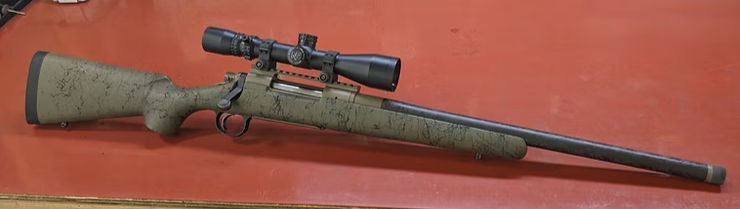
This is a compact, maneuverable bolt action built for the kind of hunting the Slayton area does best: timber edges, brushy draws, 150 to 300 yard shots. The .30-06 has more than enough energy for any deer at those distances and has been doing the job in Minnesota for generations. The Proof Research barrel and blueprinted Remington 700 action take what is already a capable platform and remove the inconsistency a factory action typically introduces.
Full build post:

AR-10 .308 Winchester: The Semi-Auto Deer Platform
Christiansen Arms 16-inch carbon fiber barrel, 1:10 twist. JP FMOS carrier group with JP Enhanced Bolt. Radian charging handle. Ergo F93 Pro Stock, MFT G-27 grip. Rise Armament 3lb trigger. Harris bipod. Eotech Vudu 2.5-10x44 with American Defense QD mount. OSS BPR27GV suppressor. Full Cerakote finish.
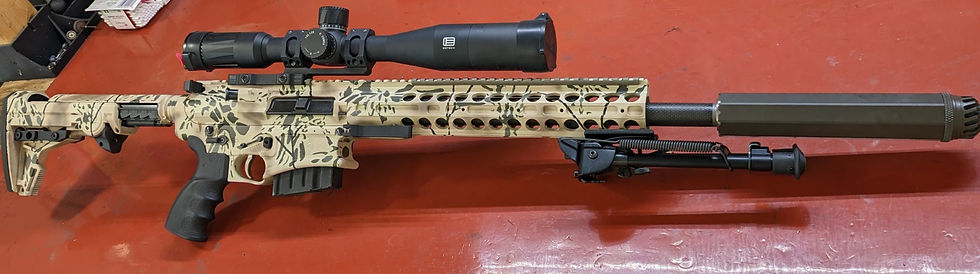
The AR-10 in .308 is the semi-automatic answer to the bolt action deer rifle question. The 16-inch carbon fiber barrel keeps weight down while the .308 delivers the energy needed for clean deer kills at 300 yards. The OSS suppressor makes this a hearing-safe setup in timber or field. If you want AR-platform ergonomics and follow-up speed with genuine deer-capable ballistics, the AR-10 in .308 is the direction to go. It is a heavier and more expensive platform than the AR-15 but significantly more capable at distance.
Full build post:

Wilson Combat WC-10 .243 Win: The Lightweight AR-10 Coyote and Deer Build
Client near Luverne, MN. This is the build that answers the AR-10 weight question directly. Everything on it was chosen to minimize weight while keeping the large-frame AR-10 platform and its .243 Win ballistics. Wilson Combat WC-10 lower with custom tan desert camo Cerakote. Proof Research 22-inch carbon fiber barrel. Lancer carbon fiber forearm. Lancer carbon fiber stock. JP Enterprises bolt carrier group and buffer system. Radian charging handle, chosen specifically because it is larger and easier to run with a scope mounted close and gloves on. Nightforce 5-25 scope. HuxWorks Titanium .30 cal flow-through suppressor. Magpul two-point and single-point sling. Complete Cerakote and suppressor work done at Redleg.


Redleg built the ammunition: 87-grain Hornady on Starline brass at 3,020 fps. Full dope card built and verified from 100 to 1,000 yards. Group shot at 100 yards confirmed sub-MOA. This rifle has been in the field near Luverne taking coyotes in open southwest Minnesota terrain. The dope card has been proven at distance.
Actual Dope Card: .243 Win, 87gr, 3,020 fps, Starline Brass, Zero at 100 yards:
Distance (yds) | Elevation (MOA) | Wind 5 mph (MOA) | Wind 10 mph (MOA) |
100 | 0 | 0.31 | 0.61 |
200 | -0.76 | 0.60 | 1.20 |
300 | -2.60 | 0.91 | 1.82 |
400 | -4.88 | 1.25 | 2.49 |
500 | -7.50 | 1.60 | 3.21 |
600 | -10.46 | 1.99 | 3.97 |
700 | -13.77 | 2.40 | 4.80 |
800 | -17.49 | 2.84 | 5.68 |
1000 | -26.34 | 3.83 | 7.66 |
Load data disclaimer: The data above was developed specifically for this rifle, these components, and this chamber. It is not a starting load recommendation for any other firearm. Always begin load development at published starting charges and work up carefully in your specific rifle.

If you want to track your own load development and build dope cards for your rifles, Redleg has you covered. The same sheets we use in the shop are available as a free download. They work for any rifle, any caliber, any platform: bolt action, semi-auto, or pistol.
Download the Redleg Reloading Data Sheets free:

Client near Dovry, MN. Currently in the field. Gibbz side-charge upper. RainerArms 20-inch nitride barrel. 15-inch Keymod free float forearm. Magpul PRS stock, CAA grip. Timney trigger. Faxon nitrided bolt carrier group. JP buffer system. Integrated brass catcher for reloaders. Custom Kryptek Cerakote finish.

This is what a deer-capable AR-15 actually looks like built correctly. The 20-inch RainerArms barrel in 6.5 Grendel delivers the ballistics needed for 300-yard deer shots while staying inside the AR-15 platform. The Timney trigger, JP buffer system, and quality BCG remove the mechanical variables that make budget AR-15s inconsistent at distance. This rifle handles coyotes in February and deer in November with the same setup. Built with an integrated brass catcher because the client reloads. It is currently being used in the field near Dovry, southwest Minnesota coyote and deer country.

Full build post:


6.5 PRC Defiance Hunting Rifle: The Long Range Bolt Gun
Defiance Ruckus action, accurized at Redleg. Proof Research barrel chambered to under .0001-inch. Bore timed curve up. Crown squared to bore centerline, 5/8-24 threaded. Timney Hunter trigger at 3 lbs. MDT HNT26 lightweight chassis.

This is the build for the Minnesota hunter who wants to reach across open fields at 400 to 500 yards with confidence. The Defiance Ruckus action accurized to Redleg's standard, Proof Research barrel chambered to under a ten-thousandth, and MDT HNT26 chassis create a precision hunting tool that is still light enough to carry all day. The 6.5 PRC is the best all-around long-range deer caliber in its class. Flat enough for 400-yard field shots, enough energy for clean harvests, suppressor-friendly.
Full build post:

Currently in the Shop: 2026 Season Prep
These are the rifles currently being set up, sighted, and doped at Redleg for the 2026 season. Dope card development is underway. When results are in, this post gets updated with real data.
6mm ARC AR-15, 18-inch Barrel, Leupold VX-3, 95gr Hornady SST
Client near Lake Wilson, MN. Dual-purpose build for coyotes and deer. Currently sighting in at 100 yards with the 95-grain Hornady SST. Dope card development will follow at 200 and 300 yards. The 6 ARC in an 18-inch barrel is one of the best AR-15 setups available for Minnesota hunting. Factory setup approximately $3500 complete with optic.

Savage 334 .308 Winchester, Leupold VX-3, SilencerCo Suppressor, 150gr Tipped Remington
Client near Chandler, MN. Factory rifle being set up and doped. Currently sighting in at 100 yards with the 150-grain Tipped Remington. The SilencerCo suppressor is mounted for all testing. Dope card will be built at hunting distances once the load is confirmed.

Custom Builds in Load Development
A 25 Creedmoor on a Coup de Grace action with Bartlein barrel, Masterpiece Arms chassis, Nightforce scope, and Scythe suppressor is in full load development.
A 6 PRC on an Impact action with Bartlein carbon barrel and AG Composite stock is also in load development.
A 6 Creedmoor on a Bergara action with Lijia barrel and Grayboe stock rounds out current custom builds.
All custom builds are pillar bedded with blueprinted actions. All will have verified sub-MOA accuracy and completed dope cards before leaving the shop. These custom builds run $5,000 to $15,000.
What We Consistently See at Redleg
The hunters who come in asking about AR-15 vs bolt action for deer almost always have already made an emotional decision about the platform. They want confirmation. What we actually do is start with the shot distance conversation. because the caliber options available in the AR-15 platform narrow significantly beyond 350 yards, and most Minnesota field hunters are shooting farther than they realize.
We also see hunters who bought a factory AR-15 in .223 or 5.56 and are surprised when we tell them it is the wrong tool for deer at distance. The platform is capable. The caliber is not. Rebuilding an AR-15 upper in 6 ARC or 6.5 Grendel is a straightforward path to a legitimate deer rifle. but it is a conversation that should happen before the purchase, not after.
On the bolt action side, we see hunters who have quality rifles they have never properly developed a load for. They are shooting factory ammunition that may or may not be optimal for their specific chamber, at a 100-yard zero that tells them nothing about 300-yard performance. The rifle is capable of far more than they are getting from it. Load development and a real dope card change that.
The hunters who make the best decision on platform are the ones who answer two questions honestly before they start: Where will my shots actually be? And what am I willing to invest in the setup to make it perform correctly at that distance?
If your rifle isn't performing the way it should. there's a reason.
If you are trying to figure out which platform and caliber to build before the 2026 deer season, we can help you work through that decision based on your actual hunting conditions.
Redleg builds both platforms. We do full load development on every custom build. We build dope cards from real data.
507-677-6007
Chandler, MN
Which article brought you here? Tell us when you reach out.
Brandon Lolkus, owner of Redleg Company, holds a gunsmithing and machining degree from Pine Technical College and trained directly under Gordy Gritter. Redleg operates under a Type 7 FFL and Class 2 SOT. Every barrel chambered at Redleg runs to under .0005 inch runout, a benchrest standard. Brandon is a combat veteran, Army National Guard, retired. The builds in this post are not spec sheets pulled from a catalog. They are rifles that came out of this shop, were load developed in this shop, and have dope cards built from real data at real distances.
A Note on Legal Compliance for the 2026 Season
The repeal of Minnesota's shotgun zone takes effect for the 2026 deer season. However, counties that were previously in the shotgun zone have the option to pass local ordinances maintaining shotgun-only or more restrictive rules. Before hunting in southern Minnesota in 2026, verify whether your specific county has passed such an ordinance. The Minnesota DNR maintains updated county-level regulations. Do not assume statewide legality covers your specific county without checking.
Additionally, Minnesota has minimum caliber and bullet requirements for deer hunting. Verify that your specific load meets the current Minnesota DNR requirements for the 2026 season. Regulations can change between print cycles.
Frequently Asked Questions
Is an AR-15 legal for deer hunting in Minnesota in 2026?
Yes. The 2025 Minnesota Legislature repealed the shotgun-only zone effective for the 2026 deer season. Rifles, semi-automatic rifles like the AR-15, and AR-15 pistol configurations with a brace are all legal statewide. Minnesota's minimum caliber requirement is centerfire and at least .22 caliber. Every caliber discussed in this post meets that standard. The exception is that counties previously in the shotgun zone may pass local ordinances to maintain restrictions. Always verify your specific county's regulations with the Minnesota DNR before hunting.
What is the best AR-15 caliber for deer hunting?
The 6mm ARC and 6.5 Grendel are the two best AR-15 calibers for Minnesota deer hunting. Both deliver adequate energy and flat trajectories for shots out to 300 to 350 yards, which covers most Minnesota field hunting scenarios. The 6 ARC has a slight ballistic advantage with higher-BC bullets and works well for dual-purpose coyote and deer use. The AR-10 platform in .308 Winchester or 6.5 Creedmoor adds range and energy but at the cost of a heavier, more expensive platform.
Is a bolt action more accurate than an AR-15 for deer hunting?
Both platforms are capable of sub-MOA accuracy with quality builds and matched ammunition. The bolt action has a consistency advantage in varying field conditions. temperature changes, cold barrel behavior, and suppressor use are all simpler variables to manage in a bolt action. At hunting distances under 300 yards, the practical accuracy difference between a quality AR-15 and a quality bolt action is minimal. At 400 yards and beyond in real field conditions, the bolt action's consistency advantage becomes more meaningful.
Can I use a suppressor on an AR-15 for deer hunting in Minnesota?
Yes. Suppressors are legal for hunting in Minnesota with the appropriate NFA registration. On an AR-15, suppressor use requires attention to gas system tuning. a suppressor increases back-pressure and can cause over-gassing in a semi-automatic action. An adjustable gas block or suppressor-specific buffer is often needed for reliable suppressed operation. Bolt actions are significantly simpler to run suppressed and do not require gas system adjustments.
How far can I shoot deer with an AR-15 in 6mm ARC?
A properly built AR-15 in 6 ARC with quality ammunition and a verified dope card is capable of clean deer kills at 300 to 350 yards in typical Minnesota field conditions. Beyond 350 yards, the 6 ARC begins to lose meaningful advantage over larger calibers at the energy levels needed for reliable deer harvests. If your shots are consistently 400 yards and beyond, a bolt action in 6.5 PRC or larger is a better platform choice.
What does a complete deer hunting rifle setup cost at Redleg?
Factory-based setups. production rifle with quality optic, suppressor, dope card development, and sighting. run approximately $6,000 complete. Custom builds with blueprinted action, Bartlein or Lijia barrel, custom stock, premium optic, and suppressor run $5,000 to $15,000 depending on component selection. All builds, factory or custom, are held to sub-MOA accuracy as a minimum standard and include full dope card development before leaving the shop.
Is a .300 Blackout AR pistol a good deer rifle for a young hunter?
Yes, within its range limitations. A .300 Blackout AR pistol with a 10 to 12-inch barrel and a 110 to 125-grain bullet is a legitimate deer setup out to 100 to 150 yards. It is shorter and lighter than a full-length rifle, easier for a young hunter to handle, and the recoil is minimal. Redleg has built a number of these specifically for youth hunters. The key is understanding what it is and what it is not. It is not a 300-yard rifle. It is a timber and field-edge setup for shots inside 150 yards. For a young hunter taking their first deer in tight cover near a tree stand or food plot, it is an excellent choice.
Is the AR-10 too heavy for deer hunting?
A standard AR-10 with a steel barrel runs 9 to 11 lbs scoped. That is heavier than most bolt actions and significantly heavier than an AR-15. For hunters who walk long distances in the field, that weight penalty is real. However, a carbon fiber build using a Proof Research barrel, Lancer carbon fiber forearm, and carbon fiber stock can bring a .243 Win AR-10 down to 8 to 9 lbs, competitive with many hunting bolt guns. The tradeoff is cost. A carbon-fiber-equipped AR-10 costs more than a standard build. The decision comes down to whether you need semi-automatic follow-up capability enough to justify the weight and cost over a bolt action at the same price point.
Should I build an AR-15, AR-10, or buy a factory bolt action for the 2026 deer season?
If your shots are under 350 yards and you want dual-purpose coyote and deer capability at the lowest weight, the AR-15 in 6 ARC or 6.5 Grendel is the best starting point. If you want semi-automatic follow-up speed with .243 Win or .308 ballistics and can accept the additional weight, the AR-10 is the answer. If your shots are regularly 300 to 500 yards and you want the simplest suppressor setup and maximum caliber flexibility, a factory bolt action in 6.5 PRC or .308 is the right direction. All three platforms run approximately $6,000 complete with optic, suppressor, and dope card development at Redleg.
Do I need a different scope for an AR than for a bolt gun?
Not different in quality, but usually different in mounting. An AR needs more height and a longer eye relief window because of receiver height. A one piece cantilever mount solves most of it. The mount still has to be square and torqued properly, which is where most accuracy complaints on either platform start.
Which platform is easier to make accurate?
A bolt action, generally, because fewer moving parts influence the shot and the action can be bedded solidly. That is a tendency, not a rule. A well built AR-10 with a good barrel and a properly bedded barrel extension will outshoot a mediocre bolt gun without difficulty.
What should I check on my deer rifle before the opener?
Base and ring screws at the maker's torque spec, action screws even and at spec, a free floated barrel, and a confirmed zero shot with the ammunition you will actually hunt with. Most opening weekend accuracy problems are a screw that backed off in the safe, not the rifle.
What to Read Next
Now that you know which platform fits your hunting, the next thing most hunters skip is understanding how all the components of that rifle system actually work together. A bolt action in 6.5 PRC with a bad bedding job and an inconsistent load is not better than an AR-15 in 6 ARC that is properly set up. Before you decide which build to order, the complete system breakdown explains exactly what to look for:
What Actually Makes a Rifle Accurate: A Complete System Breakdown:

And if the rifle you already own has started acting up, diagnose it before you spend a dollar on a new platform:
When a Rifle Suddenly SHOOTS BAD: the most common causes and how we diagnose them at Redleg:

Track Your Own Load Development
Every rifle in this post was developed using structured load workup sheets that track brass, powder, primer, seating depth, velocity, and group data across every session. That process is what separates a rifle with a real dope card from a rifle that was just zeroed at 100 yards and called done.
The same sheets we use at Redleg for every customer build are available as a free download. They work for any rifle, any caliber, any platform: bolt action, AR-15, AR-10, or pistol. If you are serious about getting real performance from your rifle, tracking your data is where it starts.
Download the Redleg Reloading Data Sheets free:
Spring is the right time to make this decision and start a build.
Custom builds take time. Load development takes time. Dope cards take range time.
If you want a rifle ready for November 2026, the decision needs to happen now.
Redleg builds AR-15, AR-10, and bolt action hunting rifles. We do full load development. We build real dope cards. We can also build your ammunition.
Shop availability is better in spring than it will be in August.
507-677-6007
Chandler, MN. Veteran Owned
Which article brought you here? Tell us when you call.

Final Thoughts
The AR-15 vs AR-10 vs bolt action debate for deer hunting does not have a single right answer. It has a right answer for your specific hunting conditions, your shot distances, how far you carry the rifle, and what you are willing to invest in the setup.
What we know from building and shooting all three platforms is this: the platform is not the variable. The caliber, the build quality, the load development, and the dope card are the variables. A hunter with a factory bolt action in 6.5 PRC and a verified dope card will outperform a hunter with a $3,000 custom AR-10 in the wrong caliber with no field data every single time.
2026 is a historic year for Minnesota deer hunting. For the first time in over 80 years, hunters across the state have full platform flexibility. Use that flexibility to make the right decision for your hunt. Not the most popular one on the internet.
If you are serious about getting this right the first time, not guessing, reach out.
We ship completed builds and return customer rifles nationwide after service work.
507-677-6007
Last updated: July 2026 | Data based on rifles currently built, tested, and in load development at Redleg Company, Chandler, MN.


Comments