
Barrel Threading for Suppressors: What Actually Matters

Updated: Sep 21
Introduction: Threading Is Not a Simple Job
Every week, rifles come into the Redleg shop that used to shoot well. The suppressor gets blamed. The ammo gets swapped. The optic gets checked. And the problem doesn't go away because none of those things caused it. In almost every case, the issue starts at the muzzle, and it started the day the barrel was threaded.
Most shooters think barrel threading is simple.
Cut threads.
Screw on a suppressor.
Done.

That assumption is exactly why rifles show up in our shop with problems that have nothing to do with ammo, optics, or the shooter.
rifle won’t group
getting flyers at distance
inconsistent velocity
What changed?
Not the optic.
Not the ammo.
Not the shooter.
The interface between the barrel and suppressor.
Barrel threading is not a finishing step.
It is a precision alignment operation and when it’s wrong, the entire system is off.
At Redleg Company, we see this pattern constantly. Shooters assume the suppressor caused the issue, when in reality it simply exposed a mechanical problem introduced during threading.
If you care about accuracy, consistency, and protecting your suppressor, this is one of the most important parts of your rifle system.
Want to understand how this fits into full rifle performance?

Who This Article Is For
This article is for shooters who:
Are adding a suppressor to an existing rifle
Have already installed a suppressor and noticed performance changes
Are seeing flyers at distance or inconsistent groups
Want predictable, repeatable performance
It’s especially relevant for:
Midwest hunters shooting 200 to 500 yards in wind
Precision shooters maintaining sub-MOA accuracy
Reloaders chasing unexplained inconsistency
If you expect your rifle to perform under real conditions not just at 100 yards:
This matters.
Quick Answer: What Actually Matters in Barrel Threading
Factor | What Matters |
Concentricity | ≤ 0.002" TIR to bore axis |
Thread Spec | Correct diameter AND pitch |
Fit Class | Proper 2A/2B engagement |
Engagement Length | ~0.5" to 0.75" |
Barrel Diameter | Must support thread size |
Shoulder | Square and large enough |
Crown | Must be preserved or re-cut |
Bottom line: If threading is not concentric to the bore, nothing else matters.
The Core System: What Barrel Threading Actually Involves
Barrel threading establishes the mechanical interface between your rifle and suppressor. That interface must maintain alignment under pressure, recoil, and repeated mounting cycles.
This is not cosmetic machining it is performance-critical work.

Ready to buy a suppressor?
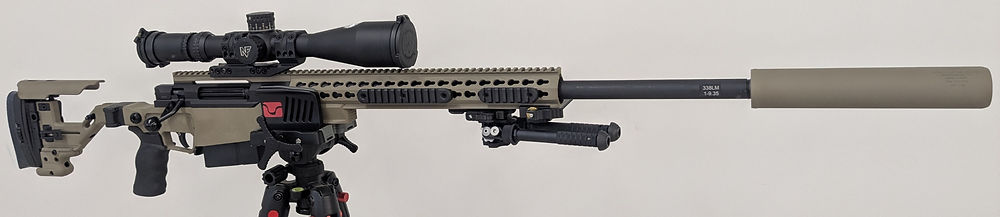
Thread Specification: More Than Diameter
Threading is defined by:
diameter + pitch + fit + geometry
Common thread pitches:
Thread | Typical Use |
1/2-28 | .223 / 5.56 |
9/16-24 | Mid-weight .243 cal |
5/8-24 | Standard .30 cal / 6.5 |
3/4-24 | Heavy barrels / magnums |
Thread size is dictated by barrel geometry not preference.
Barrel Threading for Suppressors: Minimum Barrel Diameter Requirements
One of the most common problems we see:
barrels that are too thin for the requested thread
Thread | Minimum Barrel Diameter |
1/2-28 | ~0.500" |
9/16-24 | ~0.580" |
5/8-24 | ~0.620" |
3/4-24 | ~0.750"+ |
If the barrel is too thin:
threads are weak
shoulder becomes insufficient
alignment becomes unstable
This leads directly to accuracy problems.
If the barrel diameter isn’t there, the thread shouldn’t be there.
Barrel Threading for Suppressors: Why Concentricity Matters
Concentricity is the alignment of threads to the bore axis.
Measured as: Total Indicator Runout (TIR)
Redleg Precision standard: ≤ 0.0001" TIR

Why Concentricity Matters Mechanically
If threads are off-axis:
suppressor mounts at an angle
bullet travels off-center through suppressor
gas pressure becomes uneven
This causes:
turbulence
instability
group inconsistency

At 300 to 500 yards, this becomes: missed shots
We routinely see 0.005" to 0.010" TIR from poor threading.
That WILL show up on target.
The suppressor doesn’t cause the problem. It reveals it.
Thread Fit Class: Why 2A / 2B Matters
Thread fit determines how securely the suppressor mounts.
Proper 2A/2B fit:
smooth engagement
no wobble
repeatable alignment
Loose threads:
shift under recoil
lose consistency
degrade accuracy

Thread Engagement Length
Typical: 0.5" to 0.75"
Provides:
stability
proper load distribution
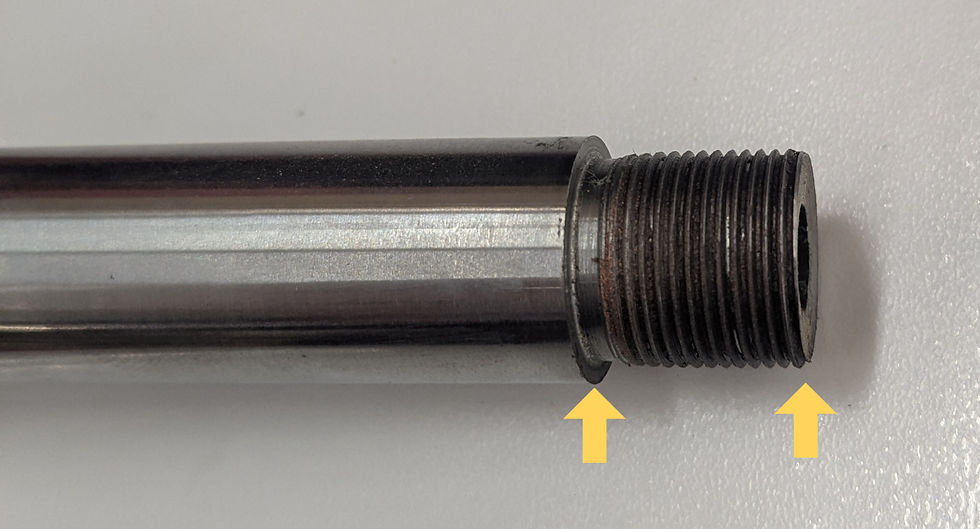
Engagement length of 0.5" to 0.75" provides the stability and load distribution a suppressor needs under recoil. Too short and the mount becomes unpredictable.
The Shoulder: The Most Overlooked Critical Surface
Many issues we see with barrel threading for suppressors come from improper shoulder geometry.
The suppressor aligns off the shoulder not the threads.
The shoulder must be:
square
perpendicular
large enough

What Happens When It’s Too Small
suppressor rides past shoulder
alignment shifts
repeatability is lost
Real Problem We See (And How We Fix It)
Thin barrels often:
cannot support 5/8-24
lack proper shoulder
Our Solution
We install a threaded shoulder extension:
increases diameter
restores alignment
creates proper seating surface

Threads hold the suppressor. The shoulder aligns it.
Muzzle Crown: Where Accuracy Is Won or Lost
The crown controls how gas exits the barrel.
If it’s uneven:
gas escapes asymmetrically
bullet destabilizes
Result:
flyers
inconsistent groups
Threading must preserve or re-cut the crown.
Common Mistakes (And Why They Cause Problems)
Most failures in barrel threading for suppressors come from a few repeatable mistakes we see every week in the shop.
Threads Cut Off Bore Axis
Leads to suppressor misalignment and inconsistent groups.
Undersized Shoulder
Causes instability and shifting point of impact.
Poor Thread Fit
Creates movement and loss of repeatability.
Crown Damage
Destabilizes the bullet at exit.
This is what that looks like.

Most shooters try to fix ammo.
The real problem is mechanical.
System Integration: Threading Is Part of the System
Threading affects:
Barrel harmonics (12 to 22 oz suppressor weight)
Chamber alignment
Ammo sensitivity
Learn more: Bullet Jump vs Seating Depth

Midwest Reality
At 300 to 500 yards with 10 to 20 mph wind:
small inconsistencies become misses fast
You won’t see this problem at 100 yards. You will at 400.
What Happens If You Ignore This
Performance
rifle won’t group
flyers
Financial
wasted ammo
chasing wrong fixes
Risk
suppressor damage
baffle strikes
How to Identify This Problem
accuracy drops with suppressor
inconsistent zero
suppressor loosens
What Shooters Say
“It shot great before”
“Now it won’t group”
That’s alignment.
If your rifle isn’t performing the way it should…
There’s a reason.
At Redleg Company, we diagnose full rifle systems:
threading
alignment
mechanical accuracy
Call: 507-677-6007
Email: info@redlegguns.com
Get a real answer not guesswork.
Practical Application (Where This Actually Matters)
Hunting (Real Midwest Scenario)
You’re on a whitetail at 300 yards.
Wind is running 12 to 15 mph across the field.
Your rifle is dialed. Your dope is correct.
But your threading is slightly off.
That introduces:
subtle alignment shift
inconsistent bullet exit
small deviation in flight
At 100 yards you’d never see it.
At 300 yards?
That 1 to 2 inch inconsistency becomes a miss or worse, a poor hit.
This is where mechanical precision matters.
Precision Shooting
At extended distances, suppressors increase sensitivity to system flaws.
A rifle that shoots: 0.5 MOA unsuppressed
May open up to: 1.0+ MOA suppressed
If alignment isn’t correct.
That’s because the added suppressor weight shifts barrel harmonics and can move the rifle off its optimal vibration node. When alignment is imperfect, that shift becomes inconsistent from shot to shot, and those inconsistencies compound as distance increases.
What looks like a small issue at 100 yards becomes a measurable accuracy loss at 400 and beyond.
Reloading
This is where shooters get misled.
They start adjusting:
powder
seating depth
primers
Trying to fix:
a mechanical problem
Learn more:

Decision Framework
Situation | Recommendation |
Factory rifle | Verify threading |
Thin barrel | Measure diameter |
Accuracy issues | Diagnose system |
New build | Thread correctly from start |
Continue Building Your Rifle System


What We Consistently See in the Shop
Most suppressor problems are not suppressor problems.
They are alignment problems.
Safety Note
Improper threading can create more than just accuracy problems it can create unsafe conditions.
If a suppressor is not properly aligned with the bore, the bullet may pass through the suppressor off-center. Under pressure, this can result in a baffle strike, which can damage the suppressor, damage the rifle, and in extreme cases create a safety hazard to the shooter.
One of the most immediate and visible signs of a failed threading job is a suppressor that loosens and eventually shoots off the barrel entirely... We have seen this happen inside 100 yards. It is loud, it is dangerous, and it is entirely preventable
Always verify:
concentric alignment
proper thread fit
correct shoulder geometry
This is not just about performance it’s about safety.
FAQ
Does barrel threading affect accuracy?
Yes. If threads are not concentric to the bore, the suppressor mounts off-axis, which alters bullet flight and creates inconsistency especially at distance.
What is TIR in barrel threading?
Total Indicator Runout (TIR) measures how centered the threads are relative to the bore axis. Precision work should be ≤ 0.002" to maintain proper alignment.
Can bad threading damage a suppressor?
Yes. Misalignment increases the risk of baffle strikes, which can damage the suppressor and create unsafe shooting conditions.
Can I thread any barrel?
No. The barrel must have enough diameter to support the thread pitch and create a proper shoulder. Thin barrels often require alternative solutions.
Why does my rifle shoot worse with a suppressor?
Most often, it’s due to alignment issues not the suppressor itself. Poor threading, fit, or shoulder geometry leads to inconsistent performance.
Do I need to re-zero after adding a suppressor?
Yes. Suppressors change barrel harmonics and point of impact, even when everything is properly aligned.
Suppressor Laws Just Changed Here's What It Means for You
As of January 1, 2026, the $200 NFA tax stamp on suppressors has been eliminated as part of the Big Beautiful Bill signed into law July 4, 2025.
What changed:
$200 tax stamp gone
ATF Form 4 process still required
Background check and registration still required
Wait times expect them to increase as more buyers enter the market
What this means practically: the financial barrier to suppressor ownership just dropped significantly. More shooters will be adding suppressors in 2026 than any previous year.
That makes proper barrel threading more important than ever not less.
If you've been putting off a suppressor setup because of the cost, now is the time to get your barrel threaded correctly before the rush.
The rifles we see that "used to shoot well but don't anymore" all have one thing in common:
something in the system is out of alignment.
And most of the time it starts at the muzzle.
At Redleg Company, we don't guess.
We identify the problem, fix it correctly, and build systems that perform the way they're supposed to.
Because accuracy doesn't come from parts
it comes from consistency.
If you're serious about fixing this the right way not guessing reach out.

Call: 507-677-6007 Email: info@redlegguns.com
Custom Build Rifle?
If you want it done right from the start…
We build complete rifle systems:
Barrel
Chamber
Threading
Suppressor integration
Built to perform not just function.
Call: 507-677-6007 Email: info@redlegguns.com
Want a clean place to log your shooting and load data? Grab our free reloading data sheet.


Comments