
6 PRC Custom Rifle Build: Impact Precision Action, Bartlein Carbon Barrel, and the Diagnostic Process Most Shops Skip

Updated: Aug 6
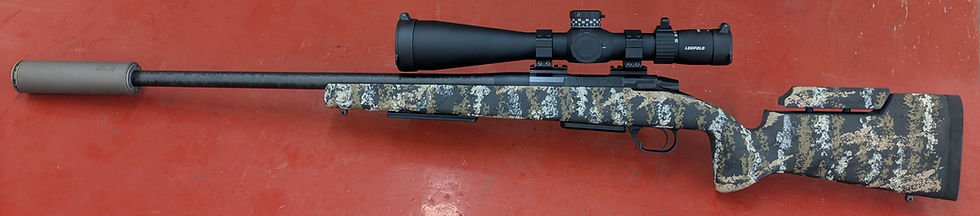
This 6 PRC was built on an Impact Precision SANBK short action with a 75 degree bolt throw, Bartlein carbon wrap barrel in 5R 1-in-9 twist chambered to under .0005 inch runout, AG Composite stock, Hawkins bottom metal, and TriggerTech Special trigger. Redleg handled chambering, bedding, threading, lug lapping, concentricity check, custom case gage manufacture, and Cerakote. Before the build was finalized, Redleg established lands measurements for three bullet weights using a fired case gage and Hornady bullet seating tool. That data confirmed the short action had sufficient magazine length for practical load development on all three bullets, which saved the customer the cost and weight of a medium action. The customer supplied a Leupold Mark 5 and SilencerCo Scythe suppressor. This post documents every component decision, every service performed, and the full diagnostic process from parts selection to first rounds on paper.
This is for precision hunters and reloaders evaluating the 6 PRC platform for a custom build who want real shop data, not manufacturer talking points.
👉 Before you commit to a platform or action, read this: What Actually Makes a Rifle Accurate: A Complete System Breakdown

Why Choose a 6 PRC Custom Rifle Build in 2026
The 6 PRC sits in a useful place in the cartridge lineup. It delivers more velocity and flatter trajectory than the 6.5 Creedmoor with manageable recoil in a short action. It runs heavier, higher BC bullets than most .243 class cartridges. And it is suppressor-friendly, which matters for a build intended for open country hunting in South Dakota where shots regularly push past 400 yards.
The factory rifle options in 6 PRC have improved but they still leave measurable accuracy on the table. A factory rifle chambers a barrel to tolerances that are acceptable for production. A properly built custom in 6 PRC chambers that barrel to benchrest standards. At 100 yards the difference is small. At 400 yards in a crosswind it shows up in whether your dope is repeatable.
This client was looking for a cartridge that could reach 500 yards reliably in the wind and still carry enough energy for a clean kill on coyotes as the primary use, with enough retained energy for antelope and deer when the opportunity comes up. The 6 PRC fills that role across all three. The 6.5 Creedmoor starts to show its limits at that distance in the wind
The 6 PRC vs 6.5 PRC
The 6 PRC pushes an 103gr ELD-X to approximately 2,970 fps from a 24 inch barrel. The 6.5 Creedmoor pushes a 143gr ELD-X to approximately 2,710 fps. At 500 yards the 6 PRC has roughly 4 inches less wind drift in a 10 mph crosswind with comparable BC bullets. That is a real difference on a South Dakota coyote, antelope, or deer at that distance.

What Most Shops Get Wrong on a 6 PRC Build
Most shops that build a 6 PRC will chamber a barrel, install a trigger, and call it done. What they skip is the diagnostic process that determines whether that chamber actually performs to the cartridge's capability.
On this build Redleg lapped the lugs, verified action ignition and concentricity, chambered the barrel to under .0005 inch runout, manufactured a custom case gage from a fired case, and established lands measurements for three bullet weights before the rifle shipped. That work is what separates a rifle that shoots from a rifle that performs.
The case gage and lands measurements in particular are steps almost no production shop performs. They are the difference between a reloader who is guessing at seating depth and a reloader who knows exactly where to start.
What We Know From the Shop
Brandon Lolkus, owner of Redleg Company, holds a gunsmithing and machining degree from Pine Technical College and trained directly under Gordy Gritter. Redleg operates under a Type 7 FFL and Class 2 SOT. Every barrel chambered at Redleg runs to under .0005 inch runout, a benchrest standard that most production shops cannot match. Brandon is a combat veteran, U.S. Army National Guard, retired. Redleg ships completed builds and returns customer rifles nationwide after service work. Current build wait is 8 to 10 weeks once parts are in.
6 PRC Custom Rifle Build Diagnostic: Short Action vs Medium Action
Before this build was finalized there was a genuine question about whether a medium action was needed. The 6 PRC with heavier bullets seated close to the lands can push COAL numbers that bump against short action magazine length limits. Ordering the wrong action is an expensive mistake that is hard to reverse.
Redleg resolved this with a fired case gage and a Hornady bullet seating tool.
The process:
A case gage is machined from a fired case from this specific chamber. The fired case conforms to the exact dimensions of the chamber it was fired in. That gage is then used with a Hornady bullet seating tool to establish where each bullet contacts the lands. The bullet is seated in the modified case, the gage is chambered, and the bullet is pushed forward until it contacts the lands. The COAL is then measured. This gives the reloader the exact starting point for load development in this specific chamber.
Results for this chamber:
Bullet | COAL at Lands | Notes |
103gr ELD-X | 2.750 inches | Well under magazine length |
80gr ELD-VT | 2.873 inches | Well under magazine length |
87gr V-MAX | 2.727 inches | Well under magazine length |
Magazine length | 2.980 inches | Short action confirmed |
All three bullets seat at or under 2.873 inches at the lands. The short action magazine length of 2.980 inches gives the reloader 107 thousandths of clearance from lands to magazine limit on the longest bullet. That is enough room to work back from the lands on any of these projectiles and still feed reliably.
Medium action not needed. Short action confirmed. Build proceeds.
This is exactly why Redleg establishes these measurements before finalizing component choices. It is a 30 minute diagnostic process that can save hundreds of dollars in components and weeks of rebuild time.
The Custom Case Gage: What It Is and Why It Gets Made
The custom case gage is a $40 service line item that most customers ask about. It is machined from a fired case from this specific chamber. The customer uses it on the reloading bench to verify every batch of sized brass falls within the headspace dimensions of this exact chamber before loading.
A case sized slightly long will not chamber correctly. A case sized slightly short will headspace loosely. A case sized to the gage will headspace the same way every time. Consistent headspace means consistent primer seating depth. Consistent primer seating depth means consistent ignition. Consistent ignition means consistent velocity. Consistent velocity means a dope card that actually holds.
For a rifle chambered to under .0005 inch runout, a custom case gage closes the loop between the chamber precision and the reloading bench. The customer now has a reference tool specific to this rifle that he will use for the life of the barrel.

The Action: Impact Precision SANBK
The Impact Precision SANBK is a short action built for the mag bolt face cartridges. The 6 PRC fits this platform correctly. The SANBK uses a Remington 700 compatible trigger footprint which made the TriggerTech Special a clean drop-in.
The 75 degree bolt throw: This is the practical hunting argument. A standard 90 degree bolt requires the knob to clear the scope objective on the way up. On a rifle with a large objective scope mounted close to the bore, that clearance becomes tight. A 75 degree throw cycles faster, requires less hand movement, and works better with the scope in a lower position. On a suppressed rifle where the scope needs to be forward to clear the suppressor diameter, the 75 degree throw matters more than it does on an unsuppressed bench gun.
The SANBK also runs a consistent lockup geometry that responds well to lug lapping. After lapping, the lug contact was verified before the barrel was installed.
Lapping the lugs means adjusting the contact surfaces between the bolt lugs and the receiver until both lugs make even, full contact simultaneously. Uneven lug contact means the action flexes differently on every shot. That inconsistency shows up as vertical stringing at distance.

The Barrel: Bartlein Carbon Wrap, 5R, 1-in-9 Twist, 22 Inch
The Bartlein Carbon Wrap uses a stainless steel liner with a carbon fiber sleeve bonded over it. The stainless liner delivers Bartlein's known accuracy track record. The carbon sleeve reduces weight without reducing rigidity.
Why 5R rifling: Standard 4-groove rifling has sharp corners at the groove-to-land transition. Those corners increase copper fouling and make the barrel harder to clean. 5R rifling uses an odd number of grooves with angled transitions that reduce fouling and clean more easily. On a hunting rifle that may go extended periods between cleanings, that matters.
Why 1-in-9 twist: The 6 PRC bullet weight range this customer is working with runs from 80 grains to 103 grains. The 1-in-9 twist stabilizes all of them. If the customer wanted to push into the 108 to 115 grain class, a faster twist would be required. For the bullets being developed here, 1-in-9 is the right choice.

Why 22 inch: The 6 PRC produces meaningful velocity from a 22 inch barrel. Going shorter loses velocity without a proportional reduction in weight. Going longer adds weight without a meaningful velocity gain for this cartridge. 22 inches is the practical hunting length for the 6 PRC.

The barrel was chambered to under .0005 inch runout verified by indicator before installation.

The Stock: AG Composite
The AG Composite stock was chosen for its combination of rigidity, weight, and inletting quality. AG Composite stocks are CNC inletted to consistent dimensions which reduces the amount of material removal needed during bedding. The stock was pillar bedded and glass bedded at Redleg after installation.

Custom Cerakote pattern was applied to the barrel, stock, and magazines. The AG Composite takes Cerakote cleanly and the sponged on camo pattern for this build was chosen by the customer for South Dakota field use.

The Bottom Metal and Magazines: Hawkins and MDT
The Hawkins bottom metal is a 3 round metal configuration chosen for hunting use. Hawkins bottom metal is known for consistent feed geometry and tight tolerances. The customer also received two MDT 10 round metal magazines for range use and longer load development sessions.

The Trigger: TriggerTech Special Curved Shoe
The TriggerTech Special uses a roller cam design that eliminates the traditional sear creep associated with most factory triggers. The curved shoe was chosen for this build based on the customer's preference. The TriggerTech Special dropped into the Impact Precision SANBK without modification due to the Remington 700 compatible footprint.
On a hunting rifle where the shot may come after a long stalk with elevated heart rate, trigger consistency is more important than it is from a bench. The TriggerTech Special delivers a clean break at a repeatable pull weight every time.
6 PRC Custom Rifle Build: Complete Specs and Service Invoice
Components:
Component | Specification | Cost |
Action | Impact Precision SANBK, mag bolt face, short action, 75 degree bolt throw | Customer supplied |
Barrel | Bartlein Carbon Wrap, .243 blank, 5R, 1-in-9 twist, 22 inch | $940.35 |
Trigger | TriggerTech Special Curved Shoe | $458.51 |
Magazines | MDT 10 Round Metal x2 | $244.95 |
Bottom Metal | Hawkins 3 Round Metal | $245.32 |
Stock | AG Composite | $1,123.00 |
Optic | Leupold Mark 5 | Customer supplied |
Suppressor | SilencerCo Scythe | Customer supplied |
Redleg Labor:
Service | Rate | Cost |
Chamber and Mark Barrel | $450 flat | $450.00 |
Crown and Thread Barrel 5/8-24 TPI | $175 | $175.00 |
Bed Rifle | $250 flat | $250.00 |
Lap Lugs, Check Action Ignition and Concentricity | $200 | $200.00 |
Cerakote Barrel, Stock, Mags | $100 | $100.00 |
Manufacture Case Gage | $40 | $40.00 |
Total Invoice (parts + labor + tax) | $4,434.21 |
The scope mounting and lapping was not performed by Redleg on this build. The customer mounted his own optic. Any build where Redleg mounts the scope goes out with rings lapped to the tube at $200.
👉 Full service pricing at: redlegguns.com/services-offered

Early Break-In and Sight-In
The customer brought existing load data from a previous 6 PRC rifle for initial break-in and sight-in on this new build. The reference load: Berger 87gr VLD, Alliant RL16 53.0 grains, Federal Red primer.
Chronograph session recorded May 1, 2026:
Shot | Velocity |
1 (cold bore) | 3355.3 fps |
2 | 3305.3 fps |
3 | 3308.3 fps |
4 | 3328.9 fps |
5 | 3320.5 fps |
Average | 3323.7 fps |
ES | 49.9 fps |
SD | 17.9 fps |
Shot 1 is a cold bore reading. It is 31.6 fps above the session average, which is typical on a clean cold barrel. Shots 2 through 5 run a 23.6 fps spread as the barrel warms. The ES and SD figures reflect a break-in session on a new barrel with a reference load carried over from a different rifle, not a tuned load for this chamber.
This data serves one purpose: getting the rifle on paper at 100 yards during barrel break-in. The customer will develop loads specific to this chamber using the lands measurements Redleg established and the custom case gage machined for this build. Velocity and group data from chamber-specific load development will be added to this post when available.
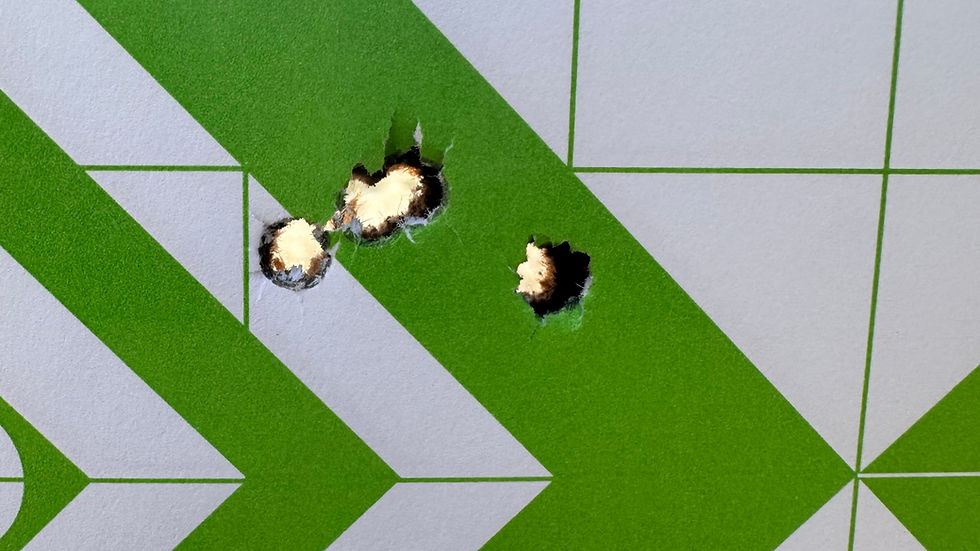
The group target confirms what the chrono data showed. The cold bore shot landed to the left of the main group. Shots 2 through 5 stacked on top of each other as the barrel reached working temperature. For a break-in session on a new barrel running a reference load from a different rifle, that is a promising start. The tight cluster in shots 2 through 5 tells you the action, bedding, and chamber are doing their job. The load development that follows will refine this further with components developed specifically for this chamber.

Load data disclaimer: The reference load and chronograph data shown above were developed for and recorded on a different 6 PRC rifle in the same caliber. This data is referenced here only to document the break-in process. It is not a starting load recommendation for this rifle or any other firearm. Always begin load development at published starting charges from a reputable reloading manual and work up carefully in your specific rifle. Redleg Company assumes no responsibility for the use of this data in any firearm other than the one it was developed for.

👉 Track your own load development from day one: Download the Redleg Reloading Sheets

What This Build Cost and What You Are Paying For
The total invoice on this build was $4,434.21. That covers the barrel, trigger, stock, bottom metal, two magazines, and all Redleg labor. It does not include the action, optic, or suppressor which were customer supplied.
A comparable build with Redleg sourcing the action adds $1,200 to $2,000 depending on action choice. Adding a Leupold Mark 5 and SilencerCo Scythe brings the complete system to the $8,000 to $10,000 range depending on exact specifications.
What you are paying for at this level is a rifle that performs to the capability of the components. The Bartlein carbon barrel chambered to under .0005 inch runout, the lapped lugs, the bedded stock, the custom case gage, and the lands measurements are not visible when you look at the finished rifle. They are what you feel at 400 yards when the dope holds.
👉 Full breakdown of what custom rifle build costs at every tier: How Much Does a Custom Rifle Build Cost in 2026

What to Read Next
The decisions made on this build, action choice, barrel selection, bedding, lug lapping, and case gage manufacture, are all components of a complete accuracy system. Understanding how they interact is what separates a shooter who knows their rifle performs from a shooter who hopes it does.
Frequently Asked Questions
Why choose the 6 PRC over the 6.5 Creedmoor for a custom build? The 6 PRC runs heavier, higher BC bullets at higher velocity than the 6.5 Creedmoor. At 400 yards and beyond, the 6 PRC has a meaningful advantage in wind deflection and retained energy. For a hunter shooting in open terrain where shots regularly exceed 350 yards, that margin is worth the cartridge choice. The 6.5 Creedmoor is a better factory rifle option. The 6 PRC is a better custom build option when the reloader is willing to develop loads specific to the chamber.
Why use a fired case gage to measure lands instead of a commercial tool? A commercial lands measurement tool gives a general measurement for the cartridge in that chamber. A fired case gage is machined from a case that was actually fired in this specific chamber, so it conforms to the exact dimensions of this chamber, not a generic specification. The fired case gage combined with a Hornady bullet seating tool gives a more precise measurement because the case is already sized to that specific chamber's dimensions.
How does the custom case gage help with load development? The case gage is machined to the headspace dimensions of this specific chamber. The reloader uses it to verify every batch of sized brass is within spec before loading. Consistent headspace means consistent primer seating depth, consistent ignition, and consistent velocity. It closes the loop between the chamber precision and the reloading bench.
What is the practical advantage of a 75 degree bolt throw on a hunting rifle? A standard 90 degree bolt requires the knob to travel a wider arc to clear the scope objective. On a rifle with a large objective scope mounted close to the bore, that clearance can be tight. A 75 degree throw requires less hand movement to cycle, works better with larger objectives, and is faster to operate in a field position. On a suppressed rifle where the scope position is often moved forward to clear the suppressor, a 75 degree throw is a practical advantage.
Why was the AG Composite stock chosen over a chassis for this build? The AG Composite provides the inletting consistency needed for a bedding job without the weight penalty of a full chassis. For a hunting rifle that needs to be carried in open terrain, weight matters. The AG Composite stock combined with a carbon barrel keeps total system weight lower than a comparable chassis build while delivering the rigidity needed for consistent accuracy.
How long does a custom build like this take at Redleg? A build at this level runs 8 to 10 weeks once parts are in. Load development adds range time on top of that. If you want a rifle ready before fall season, the conversation needs to start now.


Ready to Build?
Redleg builds for customers across the country. This 6 PRC shipped to South Dakota when the work was complete. We ship all builds and service work back nationwide.
Current build wait is 8 to 10 weeks once parts are in. If you want a rifle ready before fall season, that conversation needs to happen now.
If you are serious about a build done right the first time, reach out.
📞 507-677-6007 📧 info@redlegguns.com
Which article brought you here? Tell us when you call.
Last updated: May 2026 | Data based on rifles built, tested, and diagnosed by Redleg Company, Chandler, MN. Load data referenced in this post was developed for a different rifle in the same caliber and is not a starting load recommendation for this or any other firearm. Chamber lands measurements are specific to this rifle only.


Comments