
Bullet Jump vs Seating Depth: The Complete Guide to Rifle Accuracy

Updated: 16 hours ago
The Complete Precision Rifle Reloading Guide
Precision rifle accuracy is often attributed to barrel quality, optics, or ammunition consistency. However, one of the most misunderstood and debated variables in precision rifle reloading is bullet jump vs seating depth.
Shooters frequently experiment with seating depth adjustments without fully understanding what is happening inside the chamber and throat of the rifle during firing.
At Redleg Company, we view rifles and ammunition as an integrated mechanical system. Bullet seating depth interacts with:
chamber geometry
throat design
internal ballistics
barrel harmonics
cartridge headspace
throat erosion over time
Understanding how these variables interact allows shooters to tune ammunition intelligently instead of guessing.
This guide explains bullet jump vs seating depth, how they influence rifle accuracy, and how they change throughout the life of a barrel.


Bullet Jump vs Seating Depth : What Is Bullet Jump?
Bullet jump is the distance a bullet travels after leaving the case neck before contacting the rifling (lands) inside the barrel.
When a cartridge is chambered, the bullet is rarely touching the rifling. Instead, it must travel forward through the chamber throat before engaging the lands.
Typical bullet jump values include:
touching the lands
.005" jump
.020" jump
.040" jump
.060"+ jump
The optimal jump distance depends on several factors:
bullet design
throat geometry
powder characteristics
neck tension
barrel harmonics
Seating Depth vs Bullet Jump
Although the terms are often used interchangeably, they describe different dimensions.
Seating Depth
Seating depth describes how far the bullet is inserted into the case.
It is typically measured using:
COAL (cartridge overall length)
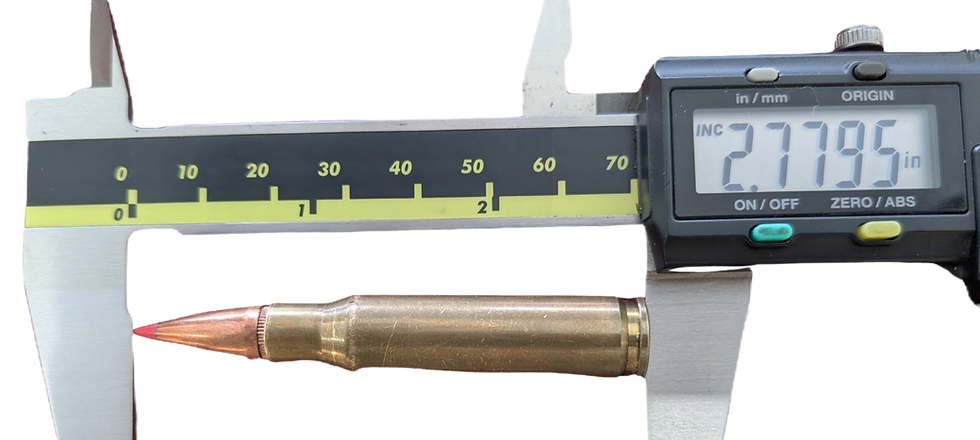
base-to-ogive measurement

Most precision reloaders prefer base-to-ogive measurements because bullet tips vary slightly.
Bullet Jump
Bullet jump is the distance between the bullet ogive and the rifling when the cartridge is chambered.

This distance depends on:
seating depth
chamber throat length
headspace position
Two cartridges with identical seating depth measurements can have different bullet jump depending on chamber geometry and shoulder bump.
What Happens When a Rifle Fires
When the trigger is pulled, several events occur in milliseconds:
Primer ignites
Powder begins burning
Chamber pressure rises
Bullet breaks free from case neck
Bullet travels through the throat
Bullet engages rifling
Bullet accelerates down the bore
The transition from free movement to rifling engagement is one of the most critical moments affecting accuracy.
The Physics of Bullet Entry Into the Rifling
As the bullet leaves the case neck it enters the throat of the chamber.
During this short travel distance several forces act on the bullet:
expanding gas pressure
throat alignment
case neck release
bullet inertia
If the bullet enters the rifling consistently and symmetrically, accuracy improves.
If the bullet enters the rifling slightly misaligned, dispersion can occur even if velocity remains consistent.

Pressure Effects of Seating Depth
Seating depth affects pressure through two competing forces.
Case Volume
Seating bullets deeper reduces case volume and increases pressure.
Seating bullets farther out increases case volume and often reduces pressure slightly.
Start Pressure
As bullets approach the lands, resistance increases.
When bullets touch or jam into the lands, pressure must build before the bullet can move.
This often produces a pressure spike.
Because of this, loads developed with bullet jump must be reduced and reworked carefully when approaching the lands.
Example: Seating Depth Changes in .308 Winchester
Example configuration:
Cartridge: .308 Winchester Bullet: 150 grain Twist: 1:10 barrel Powder: Varget Charge: 46.0 grains
Bullet Jump | Pressure Behavior |
.080 | lower start pressure |
.050 | slightly increased pressure |
.030 | moderate pressure |
.015 | sensitive pressure |
.005 | very sensitive |
touching lands | pressure spike possible |
jammed | significant pressure increase |
Velocity differences may be small, but pressure behavior becomes increasingly sensitive near the lands.
Carbon Buildup and Accidental Jamming
Carbon buildup in the throat can reduce bullet jump.
A load originally developed with:
.010" jump
may become touching or jammed due to carbon buildup.

Measurement tolerances can also stack from:
bullet ogive variation
comparator differences
caliper tolerance
For hunting rifles, maintaining .010, .020 jump provides a useful safety margin.
Why Some Rifles Shoot Best With Large Bullet Jump
Many shooters believe bullets must be seated close to the lands.
This is not always true.
Factory rifles often have longer throats to accommodate factory ammunition.
These rifles may have jump distances of:
.080
.100
sometimes more
Modern bullet designs especially hybrid ogive bullets are very tolerant of jump.
Many rifles produce excellent accuracy without approaching the lands.
Magazine Length Limitations
Many rifles cannot feed cartridges long enough to reach the lands.
Reloaders must work within constraints such as:
magazine length
reliable feeding
sufficient neck tension
In practical hunting rifles, loads are often optimized within magazine constraints rather than land contact.
Shoulder Bump, Headspace, and Bullet Jump
Headspace and shoulder bump influence bullet jump.
In bottleneck cartridges the case shoulder determines where the cartridge stops in the chamber.

If shoulder bump is increased during resizing:
The cartridge sits farther forward in the chamber, increasing bullet jump.
If shoulder bump is minimal:
The cartridge sits farther rearward, reducing bullet jump.
Two cartridges with identical base-to-ogive measurements may therefore have different jump depending on shoulder bump.
Typical shoulder bump values:
.001, .002 bolt rifles
.003, .004 semi-auto rifles

Throat Erosion and Chasing the Lands
As barrels accumulate rounds, the throat gradually erodes.
This moves the rifling forward and increases bullet jump.
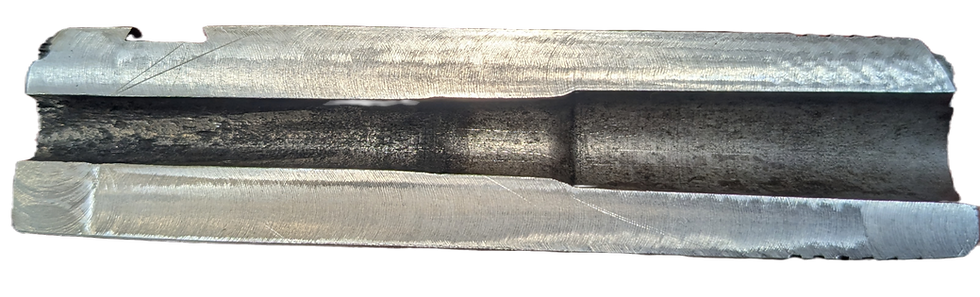
Some reloaders compensate by gradually seating bullets farther out. This is known as chasing the lands.
However this introduces practical issues:
magazine length limits
reduced neck tension
feeding reliability
For many hunting rifles, seating depth can remain unchanged until accuracy begins to decline.
Barrel Tuners vs Seating Depth Tuning
Competitive shooters often tunes accuracy using a different method.
Rather than adjusting seating depth, he maintains consistent ammunition and adjusts an EC barrel tuner mounted on the muzzle.
The tuner alters barrel harmonic frequency.
Both methods solve the same problem:
Synchronizing bullet exit timing with stable barrel vibration.
Hunters typically tune ammunition instead because suppressors and brakes already affect muzzle mass.
Bullet Jump Calculator
You can estimate bullet jump using the following method.
Step 1: Measure Chamber Base-to-Ogive

Example:
2.294

Step 2: Measure Cartridge Base-to-Ogive
Example:
2.130

Step 3: Calculate Bullet Jump
Bullet Jump = Chamber BTO, Cartridge BTO
Example:
2.294 to 2.130 = .164 jump
Adjust for Shoulder Bump
If shoulder bump is .002:
Adjusted jump:
.030 + .002 = .032 jump
This illustrates why consistent shoulder bump matters for precision loads.
Typical Bullet Jump Ranges
Rifle Type | Typical Jump |
Factory hunting rifle | .040, .200 |
Precision rifle | .010, .040 |
Benchrest | .000, .020 |
Magazine-limited rifles | .050, .120 |
Seating Depth Test Method
To find accuracy nodes:
Develop safe powder charge
Load cartridges at different seating depths
Use increments of .010
Fire groups
Identify accuracy nodes
Frequently Asked Questions
What is bullet jump?
Bullet jump is the distance a bullet travels before contacting the rifling.
Does seating depth affect rifle accuracy?
Yes. Seating depth affects pressure curves, internal ballistics, and barrel harmonics.
Should bullets touch the lands?
Not necessarily. Many rifles shoot extremely well with moderate jump distances.
Why do factory rifles have large bullet jump?
Manufacturers cut longer throats to accommodate many bullet types safely.
Does throat erosion increase bullet jump?
Yes. As barrels wear, the rifling moves forward and bullet jump increases.
Can carbon buildup change bullet jump?
Yes. Carbon fouling can effectively shorten the throat and reduce jump.
Final Thoughts
Bullet jump and seating depth are powerful tuning variables.
However they must be understood within the larger rifle system including:
chamber geometry
headspace
throat erosion
barrel harmonics
bullet design
Precision results from understanding the entire system, not just a single dimension.
Download the Redleg Reloading Data Sheets
Load development becomes much easier when you track every variable.
Download the Redleg Reloading Data Sheets to record:
seating depth tests
powder charge ladders
velocity data
group sizes
rifle and barrel information
These are the same sheets used during Redleg precision rifle load development.

Seating depth work happens at the bench. For the hands-on side of it, see Primer Seating, Powder Charging & Bullet Seating, With Redleg Techniques.


Comments