
How to Buy a Suppressor in 2026: The Complete Guide

Updated: Jul 23
If you have been waiting to buy a suppressor, 2026 is the year. The $0 NFA tax stamp changed everything.
On January 1, 2026, the federal NFA transfer tax on suppressors dropped to zero. That single change sent 150,000 e-Forms into the ATF system on day one alone. If you are a Minnesota hunter trying to figure out how to buy a suppressor in Minnesota in 2026, this guide covers the full process from choosing the right can to getting it installed and zeroed. Normal daily volume before that was around 2,500. Every hunter and shooter in the country is asking the same question right now: how does this actually work, and how do I get one?

Most of the answers online walk you through the ATF paperwork process in a vacuum. They do not tell you what it looks like when you work with a local Class 2 SOT dealer who handles the process for you, matches you to the right suppressor for your specific rifle, installs it correctly, and makes sure your groups do not open up after you mount it.
That is what this guide is for.
👉 If you already own a suppressor and your groups changed after mounting it, start here first: Barrel Threading for Suppressors: What Actually Matters

Who This Guide Is For
This is for any Minnesota hunter or shooter who has been thinking about buying a suppressor but has not pulled the trigger on it yet. You may have heard that the process is complicated, expensive, or takes a year to complete. Some of that was true in the past. Most of it is no longer accurate.
This guide is also for the shooter who already knows they want one but is trying to figure out which suppressor is right for their specific rifle. A .30 caliber can on a lightweight hunting rifle is a different decision than a flow-through suppressor on an AR-15. Those decisions matter and most dealers do not walk you through them.
Quick Answer: How to Buy a Suppressor in Minnesota in 2026
Step | What Happens | Who Handles It |
1. Choose your suppressor | Match caliber, weight, and host rifle | Redleg advises and orders through dealer accounts |
2. Pay for suppressor | Full payment at time of order | Customer pays Redleg |
3. Fingerprints | Visit local Sheriff / Police Dept or Use Kiosk | Customer Sheriff / Police or NFA Seller |
4. ATF eForm 4 | Application submitted digitally | Redleg handles all paperwork |
5. Trust (optional) | NFA trust for shared ownership | Redleg sets up if customer wants one |
6. ATF approval | Approval comes back digitally | Current timeline: days to weeks in 2026 |
7. Installation | Suppressor installed and zeroed | Redleg installs, zeros, and builds dope card |
NFA transfer fee | If buying suppressor through Redleg | $0 included when you buy the can from us |
NFA transfer fee | If you already own the suppressor | $150 |
The short version: Come to Redleg, pick your suppressor, we handle the ATF paperwork, you stop by the Sheriff/Police for fingerprints, and when approval comes back we install it and get you zeroed. That is the whole process.

The $0 Tax Stamp: What Actually Changed in 2026
For decades, buying a suppressor required a $200 federal NFA tax stamp. The money went to the federal government as part of the National Firearms Act transfer process. That $200 did not go away quietly. It was a friction point that kept a lot of buyers on the sideline.
As of January 1, 2026, that stamp is $0. The paperwork process itself has not changed. You still submit an ATF Form 4, you still go through a background check, and the suppressor still transfers through a licensed dealer. What changed is that the $200 cost is gone.
The result was immediate. ATF eForms saw 150,000 submissions on January 1 alone. For context, a normal day before 2026 was around 2,500. The demand was there all along. The cost was the barrier.
If you have been waiting for the right time, this is it.
Buying a Suppressor in Minnesota: What the Law Actually Says
Yes. Suppressors are legal to own and use for hunting in Minnesota. There is no state-level permit required beyond the federal NFA process. Minnesota law allows suppressors for hunting most game species including deer, bear, and predators.
One thing to understand: Minnesota does require that NFA transfers go through a licensed dealer who holds the appropriate SOT license. Redleg holds a Type 7 FFL with a Class 2 SOT. That means we are fully licensed to sell, transfer, and work on suppressors. You are in the right place.
A note on local jurisdictions: some Minnesota counties have had additional local transfer requirements in the past. We stay current on those regulations. If you are in Murray County or the surrounding area, call us before assuming anything and we will tell you exactly what applies to your situation.
How to Buy a Suppressor in Minnesota: The Complete Process at Redleg

Step 1: Choosing the Right Suppressor
This is the step most people skip and most dealers rush. The wrong suppressor for your rifle is money wasted. We order through large distributor accounts in the industry which means we can access nearly any suppressor on the market and get competitive pricing.
Before we order anything, we want to know:
What is the host rifle? A suppressor that works on an AR-15 in .223 is not the same choice as one for a bolt action .300 Win Mag hunting rifle. Caliber, barrel thread pitch, and host rifle weight all determine which suppressor makes sense.
What are you using it for? Hunting, range shooting, and AR use each have a different ideal suppressor type. We cover the specific recommendations in the section below.
Step 2: Fingerprints
Here is the one thing Redleg does not have that some larger suppressor dealers do: an on-site fingerprint kiosk. We do not have one yet, though we are working toward getting one so we can do the entire process in house.
In the meantime, the Sheriff's office handle fingerprints for our customers and the process is straightforward. You get your fingerprint cards, bring them to us, and we take it from there. It adds one extra stop to the process but it has not been a problem for any of our customers.
Step 3: ATF eForm 4 Submission
We handle all of the ATF paperwork. The Form 4 is submitted digitally through ATF eForms. You do not need to figure out the federal paperwork system. That is what you are working with a Class 2 SOT dealer for.
If you want to set up an NFA trust for shared ownership with family members or to simplify future transfers, we can handle that as well.
Step 4: Waiting for Approval
In 2026, ATF eForms approval times have dropped significantly. Some customers are seeing approvals come back within days. Times can vary based on volume and individual application complexity, but the era of waiting 12-18 months is behind us for most straightforward applications.
Step 5: Installation and Zero
When approval comes back, the suppressor is yours. We install it, confirm the threading is correct, zero the rifle with the can mounted, and document any point of impact shift. A suppressor changes where your rifle hits. It always does to some degree. How much depends on the threading, the barrel, and the specific suppressor. We account for all of it before the rifle leaves the shop.
Which Suppressor Is Right for Your Rifle
Not sure which suppressor fits your rifle? That is the most common question we get. Caliber, barrel profile, barrel weight, and intended use all factor into the right answer. Call us before you order anything.
📞 507-677-6007 📧 info@redlegguns.com
Which article brought you here? Tell us when you call.
Flow-Through Suppressors for AR Platforms
The biggest problem AR shooters have with suppressors is gas blowback into the shooter's face. A standard suppressor on a direct-impingement AR creates a significant increase in back-pressure. Gas comes back through the charging handle and into your eyes. If you have ever shot a suppressed AR and ended up with powder residue on your face, that is exactly what happened.
Flow-through suppressors are designed specifically to address this. They redirect gas flow in a way that dramatically reduces blowback compared to a standard baffle suppressor. For AR platforms, this is the design we recommend.
HuxWrx builds some of the best flow-through suppressors available. Sig Sauer and other manufacturers are now entering the flow-through market as well, which is creating more options at more price points. If you are running an AR-15 or AR-10 and want to suppress it properly, a flow-through can is the right starting point.


Lightweight Suppressors for Hunting Rifles
The most common mistake hunters make when suppressing a bolt action is putting a heavy can on a lightweight rifle. A 20-ounce suppressor on a 6-pound hunting rifle changes the balance, adds fatigue on a long carry, and stresses the barrel threads in ways that compound over time.
The rule is simple: match the suppressor weight to the rifle weight. If you built or bought a lightweight rifle, put a lightweight suppressor on it.
The HuxWrx titanium suppressors are a standout for this application. We used a HuxWrx titanium on the Ar15 223 wylde pistol build for a client near Lake Wilson, MN. That pistol runs a Rainer Arms 12-inch barrel and was built specifically to stay light for use in open southwest Minnesota terrain. A heavy steel suppressor would have defeated the purpose of the entire build. The HuxWrx titanium kept the weight profile of the rifle where it needed to be.

The SilencerCo Scythe is one of our most consistent top sellers for hunting rifle applications. It handles a wide range of calibers, performs well across different host rifles, and has proven itself reliable in real field conditions.

.22 Suppressors
The .22 LR is where suppressors are at their most effective. A quality .22 suppressor makes a rimfire rifle hearing-safe in most configurations, which changes how shooters train and how families introduce newer shooters to the sport.

Dead Air makes one of the quietest .22 suppressors available. If a very quiet rimfire setup is the goal, that is the one we point people toward first.
What We Consistently See at Redleg
The most common conversation we have with customers who come in about suppressors is the mismatch between what they think they need and what actually fits their rifle.
Someone comes in with a bolt action .308 hunting rifle and asks for a suppressor recommendation. The first question we ask is what barrel profile and contour they are running. A heavy varmint barrel can tolerate a heavier can. A lightweight hunting profile needs a different approach. The second question is how far they are hunting. A suppressor changes the harmonics of your barrel. For shots inside 200 yards, point of impact shift is manageable. For shots at 300 to 500 yards in a 15 mph crosswind on a southwest Minnesota field, a suppressor that was not properly zeroed and doped will cost you the shot.
We also see shooters who bought their suppressor somewhere else and come to us when the installation did not go right. The most common problem is a barrel that was threaded without a proper shoulder. The suppressor seats against the outside of the barrel instead of a machined reference surface. It looks fine. It is not fine. Groups open up and the shooter blames the suppressor. The problem is the threading.
If you are buying a suppressor and your barrel is not already threaded, have it done right the first time. A barrel threading with a proper shoulder at Redleg runs $175 to $225 depending on the barrel. That is part of doing the suppressor job correctly, not an add-on.
Common Mistakes When Buying a Suppressor
Buying the suppressor before checking the barrel threads. Not every rifle barrel is threaded from the factory. Even factory-threaded barrels are not always done correctly for suppressor use. Before you order a suppressor, verify the thread pitch and whether a shoulder was machined. If the answer to either is unknown, that is a conversation to have before you spend $600 to $1,500 on a can.
Choosing caliber rating wrong. A .30 caliber suppressor will work on calibers smaller than .30, including 5.56 and .223. But it will not work on anything larger than .30. Match the suppressor's rated caliber to the largest caliber you plan to run through it. Running a smaller caliber through a larger-rated suppressor gives slightly less sound reduction but works fine. Running a larger caliber through a smaller-rated suppressor damages the baffle stack. It is not recoverable.
Ignoring point of impact shift. Every suppressor changes where your rifle hits. The shift varies by rifle, barrel, and suppressor combination. Some rifles shift half an inch at 100 yards with a can mounted. Others shift three inches. You will not know until you zero the rifle with the suppressor in place. Never assume your previous zero transfers.
Skipping the trust because it seems complicated. An NFA trust lets multiple people legally possess the suppressor, simplifies transfers if you ever sell it, and makes estate planning cleaner. If you have a spouse, adult children, or family members who may use the suppressor, a trust is worth setting up. We handle it for you.
What Happens If You Skip This Process
The NFA process exists because suppressors are federally regulated items. Possessing a suppressor without going through the Form 4 process is a federal felony regardless of what state you are in or what the item was purchased as. The paperwork is not optional. It is not something you can address later. The process must be completed before the suppressor is in your possession.
This is not meant to scare anyone. The process is straightforward when you work with a licensed dealer who knows what they are doing. It is meant to make clear that buying a suppressor from an unlicensed source, accepting one as a gift without transferring it properly, or borrowing one from a friend without having it on your paperwork are all federal violations. Work with a licensed Class 2 SOT dealer. Do the process correctly the first time.
If you want to understand why a suppressed rifle almost always requires a new zero and what factors drive the shift, the system breakdown is here:

Suppressor Pricing: What to Expect
Suppressor prices vary significantly by caliber, material, and design. As a general range for budgeting purposes:
Category | Typical Range | Notes |
.22 LR suppressors | $300 - $600 | Dead Air and SilencerCo are top performers |
Rimfire / pistol cans | $400 - $700 | Multi-cal options available |
Rifle suppressors (.223 / 5.56) | $500 - $1,000 | Flow-through design adds cost |
Rifle suppressors (.30 cal) | $600 - $1,200 | Covers .308, .300 WM, 6.5 PRC, most hunting calibers |
Titanium hunting suppressors | $900 - $1,500 | Nomad Ti OTB titanium in this range worth it for lightweight builds |
NFA transfer: $0 when you buy the suppressor through Redleg. $150 if you bring in a suppressor you purchased elsewhere.
Real Redleg Suppressed Builds
Wilson Combat WC-10 .243 Win Client near Luverne, MN
Built for dual-purpose coyote and deer hunting across open southwest Minnesota terrain. Proof Research 22-inch carbon fiber barrel. HuxWrx titanium suppressor. Lancer carbon fiber forearm and stock. JP Enterprises BCG and buffer. Leupold VX6 optic. Redleg-built load: 87gr Hornady V-MAX, Starline brass, 3,020 fps. Multiple coyotes taken at distance in field conditions. The HuxWrx titanium was specified specifically to match the lightweight build profile. The rifle and suppressor together perform as a system.

Load data developed for this specific rifle only. Not a starting recommendation for other firearms. Always begin load development at published starting charges and work up carefully in your specific rifle.
👉 Download the Redleg Precision Reloading Sheets the same tracking sheets we use for every customer build.

Henry .45-70 Southwest MN client (setup in progress)
Carbon fiber barrel. Bushwacker .45 cal suppressor. Holosun solar-charged red dot. Sighting in at 100 yards with a full dope card under development. A suppressed lever action .45-70 is an unusual combination that works extremely well for timber hunting and close-range applications. The Bushwacker handles the big-bore caliber cleanly.

AR10 .308 Win Texas Build
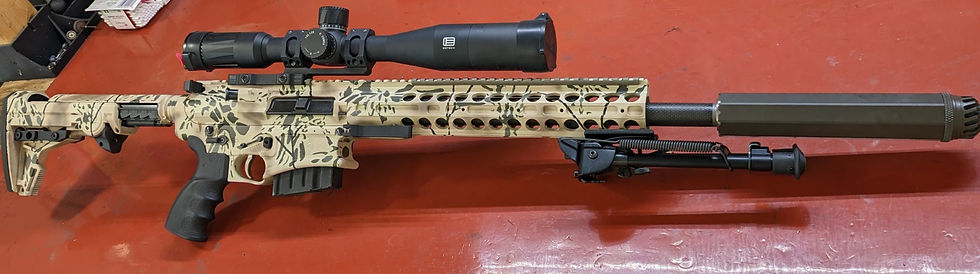
16-inch carbon fiber barrel, OSS suppressor. JP FMOS carrier. Eotech Vudu optic. Built for Texas pig hunting. OSS suppressors use a different internal flow path than standard baffles and manage gas pressure differently, which makes them a solid choice for .308 AR platforms.
Ready to Get Started
The $0 tax stamp took away the one barrier that kept most hunters on the sideline for years. The $200 cost is gone. The paperwork is still there. But the paperwork is the part we handle.
You pick the suppressor that fits your rifle. We handle the ATF forms, coordinate the fingerprints with Murray County, set up your trust if you want one, install the can, zero the rifle, and document the point of impact shift before it leaves the shop. The only thing you need to do is start.
Build slots are filling. If you want your suppressor installed and zeroed before fall hunting season, the time to start is now.
📞 507-677-6007 📧 info@redlegguns.com
Which article brought you here? Tell us when you call.
What to Read Next
The suppressor is only part of the accuracy system. If you want to understand why your suppressed rifle may shoot differently than your unsuppressed zero and what to do about it, this is the post that explains the mechanics:
The threading is where most suppressor accuracy problems start. That post covers what a proper threading job looks like, what a shoulder does and why it matters, and how to diagnose whether your current setup is the problem.
Frequently Asked Questions
Do I need a special license to own a suppressor in Minnesota? No state-level license is required. You go through the federal NFA process Form 4 submission, background check, ATF approval and that is it. Minnesota does not add any state-level permit on top of that for suppressors. Redleg handles the federal paperwork for you.
How long does suppressor approval take in 2026? Approval times have dropped significantly since the $0 tax stamp took effect. Some customers are seeing approvals in days. Others take a few weeks. ATF eForms volume is extremely high right now so times can fluctuate. We will give you a realistic expectation based on current conditions when you come in.
What does Redleg charge for the NFA paperwork? If you buy the suppressor through us, the NFA paperwork and transfer handling are included at no additional charge. If you already own a suppressor and want us to transfer it or handle a Form 4, the fee is $150. Standard firearm transfer (non-NFA) is $40.
Can my spouse or family member also use my suppressor? Not without proper legal structure. A suppressor registered to you is legally in your possession. Another person using it without being listed on the paperwork is a federal violation. The clean solution is an NFA trust, which lists all approved possessors. We set these up for customers. If there is any chance someone else in your household will use the suppressor, a trust is the right move.
Do I need to re-zero my rifle after mounting a suppressor? Yes. Every suppressor changes point of impact to some degree. The shift can be minimal or significant depending on your specific rifle, barrel, and suppressor combination. We zero every suppressed build before it leaves the shop and document the shift so you have accurate data before you go to the field.
What is a flow-through suppressor and why does Redleg recommend them for ARs? A flow-through suppressor uses a different internal gas path than a standard baffle design. On a direct-impingement AR-15 or AR-10, a standard suppressor significantly increases back-pressure and drives gas back through the charging handle into the shooter's face. A flow-through design redirects that gas differently and dramatically reduces the blowback problem. For AR platforms, it is the right design choice.
Can Redleg order any suppressor or are you limited to certain brands? We order through Bill Hick, Sports South, and RSR three of the largest distributor accounts in the industry. We have access to virtually the entire suppressor market. If you have a specific brand or model in mind, we can almost certainly get it. We will also give you our honest recommendation for your specific rifle before you decide.
Does the suppressor affect my rifle's accuracy? Done correctly, a properly fitted suppressor on a properly threaded barrel does not hurt accuracy. In some cases it improves consistency because it changes muzzle dynamics in a favorable way. Done incorrectly wrong thread pitch, no shoulder, wrong baffle rating it absolutely affects accuracy. The installation matters as much as the suppressor itself.
Two cartridges designed suppressor-first are compared in .338 ARC vs 8.6 Blackout: Which Big-Bore Fits Your Build?. Buying from out of state? Read Understanding FFL Transfers and Firearm Laws in MN.
Last updated: April 2026 | Data based on rifles built, tested, and suppressed by Redleg Company, Chandler, MN.


Comments